
 Search

 Login
Login



CREDA CRE Sentiment Index
Release Date: October 2026
Key Findings
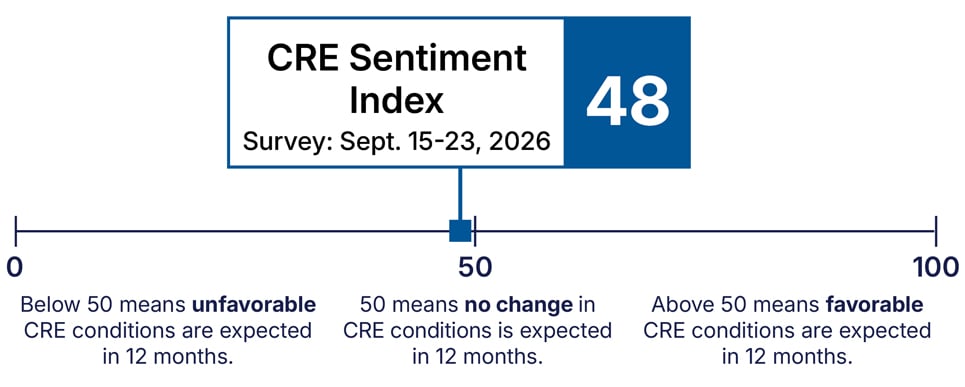
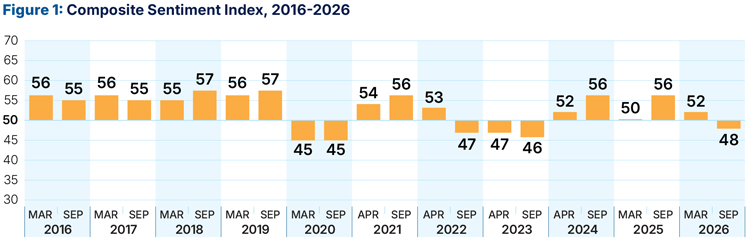
The Commercial Real Estate Development Association CRE Sentiment Index for September 2026 is 48, adecrease from the March 2026 score, indicating that respondents expect conditions for commercial real estate to worsen slightly over the next 12 months (see Figure 1).
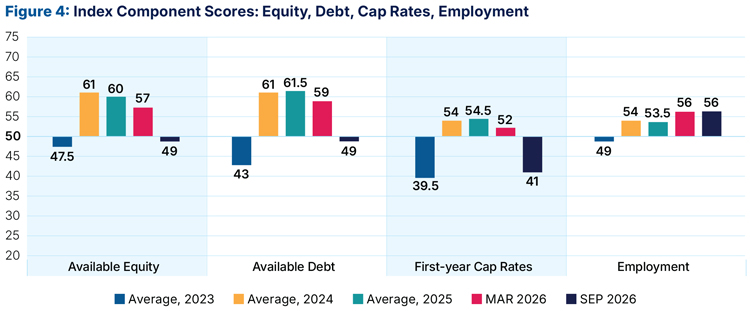
Respondents are less optimistic about capital market conditions. They expect that equity and debt will be slightly less available and anticipate that first-year cap rates will rise. Respondents are significantly less optimistic about each of these three measures than they were in the spring.
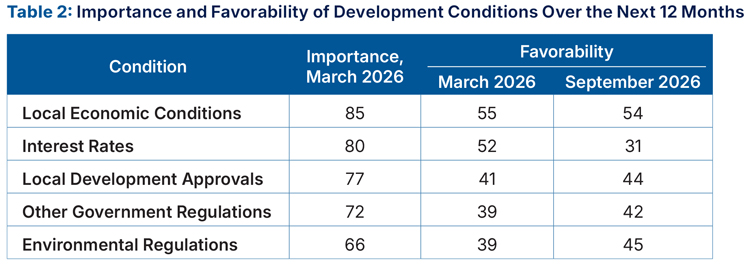
Rising interest rates are likely behind this shift. Developers and building owners indicated that they expect interest rates to be unfavorable over the next year. The favorability score for interest rates fell to 31 from 52 in March, the largest decline between surveys since April 2022, which was the last time the survey coincided with the Federal Reserve shifting to a more restrictive monetary policy.
Survey respondents expect both construction material and labor costs to rise more rapidly than they anticipated in March, and they are now more pessimistic about both measures than at any time since the April 2022 survey.
The outlook for property-level fundamentals is strong. Respondents expect face and effective rents to grow more quickly than was their expectation in March, and they continue to anticipate that occupancy rates will increase.
Developers and building owners expect an increase in the dollar volume of transactions and projects and that employment will grow slightly within their own firms. This suggests that improving fundamentals may be enough to encourage expansion despite rising interest rates and construction costs, though this environment favors investments in stabilized properties over new development.
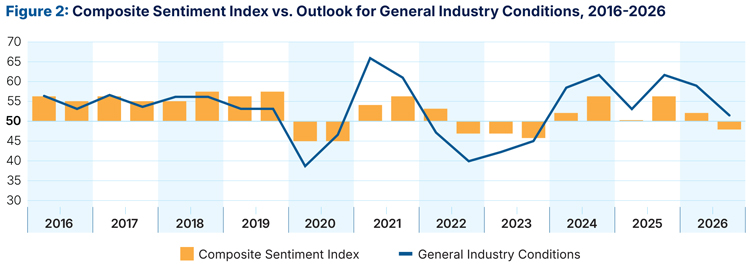
Respondents expect general industry conditions to improve slightly over the next 12 months. The score for general industry conditions (51) is calculated separately from the CRE Sentiment Index and declined from the spring survey. A slightly higher score than the CRE Sentiment Index may reflect a more optimistic outlook for the performance of existing assets than for future development projects or suggest that respondents have a favorable outlook for factors not measured in the index, such as general economic conditions. Asked separately, developers and building owners indicated they expect favorable local economic conditions over the next 12 months.
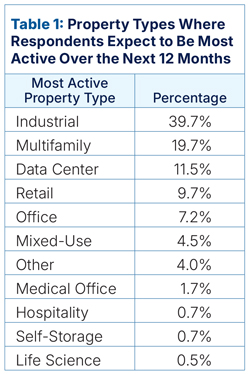
Most respondents expect to be most active in either industrial or multifamily real estate during the next 12 months (see Table 1). Data centers and retail properties attract the next highest levels of interest.
Notable Changes in the September 2026 Survey
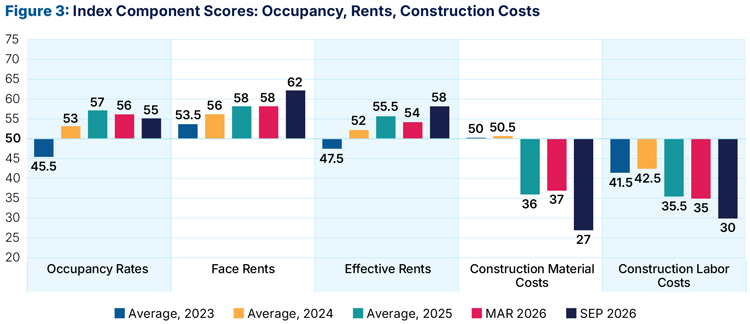
Figures 3 and 4 compare respondent expectations in September 2026 for the individual components that comprise the CRE Sentiment Index with expectations in past surveys. For component scores from before 2023, please refer to past editions of this report. Values above 50 represent expectations that a condition will be more favorable for development over the next 12 months (for example, higher face rents, lower construction labor costs, lower cap rates). Values below 50 represent expectations that a condition will be less favorable during the next 12 months.
The largest changes in the September 2026 survey reflected a sharp reversal in the outlook for capital markets and increased pessimism about construction costs. The outlook for first-year cap rates saw the steepest drop of any component, followed closely by available debt, construction material costs and available equity. Respondents’ outlook for debt and equity availability is just below neutral, but they expect a more significant increase in cap rates, which will limit potential gains in valuation from expected improvements in rental rates and occupancy. On the other hand, respondents expect effective rents to grow faster than in any survey since April 2022. Favorable property-level expectations may help to explain why respondents’ expectations for employment within their own firms remain positive and unchanged from the spring.
The two trends of more pessimistic expectations for capital markets and construction costs are related, with rising inflation expectations driven by the Iran conflict leading to the recent increase in the federal funds rate and anticipation that the Fed will raise rates again later this year. In open-ended comments, respondents linked rising material costs to higher energy prices and tariffs. Some also indicated that restrictive immigration policy was limiting the availability of construction labor. Overall uncertainty about geopolitical conditions, macroeconomic conditions, tariff policy and how the upcoming midterm elections will affect federal policy also appear to have weighed on sentiment, with respondents indicating impacts on the availability of capital and on occupier demand.
Some respondents offered mixed opinions on property-level conditions. Several noted that limited new supply continues to support demand in some markets, particularly for industrial space. Others reported slowing industrial absorption and more hesitant tenants due to economic uncertainty. A few pointed to lengthening development approval processes, with one respondent noting that opposition to data centers was also affecting approvals for other property types.
Expectations for Development Conditions
The survey asks developers and building owners to evaluate how important interest rates, local economic conditions, local development approvals processes, environmental regulations and other government regulations will be to their decisions to initiate or continue development projects over the next 12 months (answers are not factored into the CRE Sentiment Index). The survey then asks developers how favorable they expect these conditions to be. The results are described in Table 2 on a 100-point scale.
Respondents continue to rank local economic conditions and interest rates as the two most important factors in their development decisions. The largest shift was in the outlook for interest rates, which shifted from slightly optimistic to very pessimistic. The outlook for economic conditions remained positive and nearly unchanged. Respondents continue to expect that development approvals and environmental and other regulations will be unfavorable for development, although less unfavorable than they expected in the prior survey.
Differences Between Developers and Non-developers
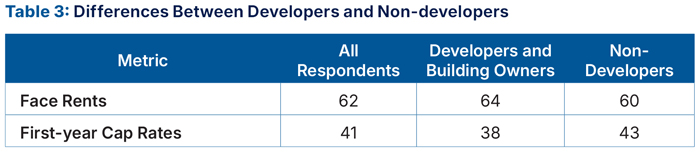
Respondents were asked to identify their primary profession. When comparing responses from developers and building owners with those of non-developers, two statistically significant differences emerged related to the conditions that comprise the CRE Sentiment Index (see Table 3). Developers and building owners expect face rents to rise more quickly than non-developers do, but they also expect first-year cap rates to rise more sharply. Developers and building owners remain confident in tenant demand for their properties but may be wary about starting new development projects in the face of rising interest rates and higher cap rates.
Direct From Survey Participants
“Besides the cost of money, the cost of construction is an issue driving the lack of deals and also the cost of deals.”
“While office is picking up, increasing construction costs will continue to outpace gently increasing rental rates affecting net effective income.”
“Overall, fundamentals should improve slightly but cost of capital will be high which skews investment decisions.”
“There are some headwinds that only time will fix. The war in Iran pushing up oil pricing – oil and construction prices are linked, the talk, threat of tariffs is affecting industrial leasing and the Fed raising rates are all something out of our control and it is the uncertainty that keeps equity on the sidelines.”
“We are seeing a slowdown in absorption, prompting discussions about asking rents and other market fundamentals. Macro trends like oil pricing, the war in Iran, and midterm elections are causing many companies to pause or move slower than desired on future real estate plans for industrial.”
“The wildcard here is at the federal level; specifically tariffs and trade policy, immigration policy […] the impact of the fiscal issues that impact interest rates, and fundamentally, the massive level of uncertainty around all of these items currently. This inhibits the efficient flow of capital and that’s the lifeblood of what we do.”
“The clunky efforts to stop all data center development are having the unintended consequences of grinding all non-data center development to a halt with overreaching regulations, moratoria threats, staff opposition to any commercial development, etc. They are using a sledgehammer to crack a walnut and destroying non-data center development that would otherwise expand the tax base, create jobs, create homes for small businesses, and locate jobs/services closer to residents.”
Methodology
The CRE Sentiment Index is designed to predict general conditions in the commercial real estate industry over the next 12 months by asking industry professionals to predict conditions for their projects and markets. The Commercial Real Estate Development Association CRE Sentiment Survey is conducted biannually, in March/April and August/September. The survey is sent to roughly 10,000 CREDA members in the U.S. who are developers, building owners, building managers, brokers, analysts, consultants, lenders and investors in commercial real estate. It asks questions about jobs, space markets, construction costs, capital markets and other conditions for real estate development.
The questions that comprise the CRE Sentiment Index are not equally weighted. Instead, weighting varies based on whether responses to a question are tightly packed or dispersed. Questions with tightly packed responses (meaning there is more consistency among the answers to that question) are more heavily weighted than those with more dispersed responses (which indicate less consistency).
If every participant in the survey selected the most optimistic answer to every question, the index would be 100. Conversely, if all the participants chose the most pessimistic response to every question, the index would be 0. The survey includes questions that evaluate sentiment about conditions that are not included in the composite sentiment index score but are measured separately on a 100-point scale.
A cross-tabulation of the September survey results by respondent profession revealed two questions in which differences between responses were statistically significant. Differences that were not statistically significant are not reported in this analysis.
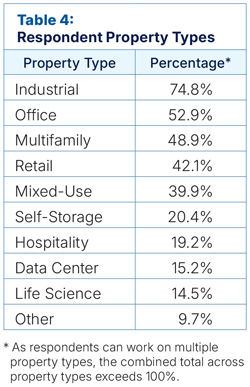
A total of 401 respondents from 299 distinct companies participated in this survey. A breakdown of the property types that respondents work on is provided in Table 4.
A regional breakdown shows that 53.9% of respondents are active in the West, 41.1% are active in the South, 30.7% are active in the East, and 27.4% are active in the Midwest.
Survey participants receive a summary of results showing the percentage breakdown of responses to each question after the survey closes. This report is released to all CREDA members and the public three to four weeks later. Survey responses for this index were gathered between Sept. 15 and Sept. 23. The response rate for this survey was 4.2%, and the margin of error for the composite index score was 4.9%.
The statistical methodology for the CRE Sentiment Index was originally developed by Tom Hamilton, PhD, MAI, CCIM, CRE, the Gerald Fogelson Distinguished Chair of Real Estate in the Chicago School of Real Estate at Roosevelt University. The survey data was collected by CREDA, and the survey questions were created, refined and finalized between 2014 and 2023 with the assistance of several CREDA Distinguished Fellows. CREDA Research Analyst Max Shpilband authored the current edition of the survey and this summary analysis. For questions about the CRE Sentiment Index, please contact Max at mshpilband@credaglobal.org.
About CREDA
The Commercial Real Estate Development Association (CREDA) is the leading global professional organization for the commercial real estate industry, representing more than 21,000 members across 55 chapters in North America. CREDA equips professionals with the resources, relationships and insights needed to advance their careers through high-impact networking, practical education and forward-looking research. As a trusted voice at the forefront of the industry, CREDA drives innovation in development by advocating for legislation that supports commercial real estate growth and delivering data-driven insights through the CREDA Research Foundation.
The Commercial Real Estate Development Association Research Foundation was established in 2000 as a 501(c)(3) organization to advance the knowledge of the commercial real estate development industry through objective research, analysis and education. By delivering data-driven insights on the industry’s economic impacts and market dynamics, the Foundation equips industry leaders, policymakers and stakeholders with information they need to make informed decisions and create thriving communities. For more information, visit credaresearch.foundation.
Media Inquiries
Please contact Brielle Scott, director of marketing and communications, at bscott@credaglobal.org.
Disclaimer
This project is intended to provide information and insights to industry practitioners and does not constitute advice or recommendations. The CREDA Research Foundation disclaims any liability for actions taken as a result of this project and its findings.
© 2026 CREDA Research Foundation