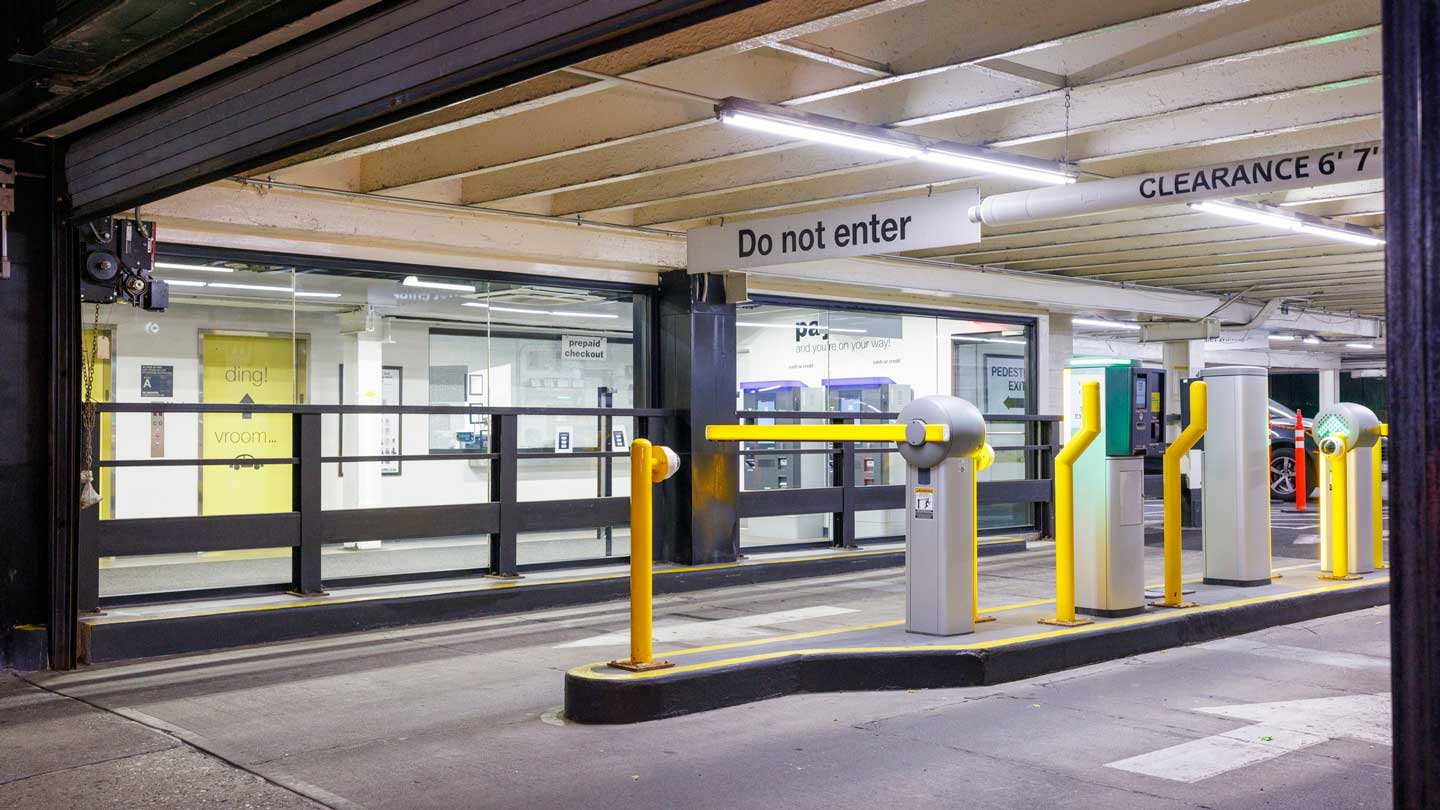
Developers are gradually learning a better way to rewrite their pro formas around parking.
In 2019, a developer in downtown Charleston, South Carolina, acquired a fragmented assemblage of parcels for $20.7 million with plans to build. Five years later, construction has yet to begin. The reason is not financing, permitting or market conditions. The reason is parking. The lot the developer has been operating in the interim now generates over $2 million in annual net operating income, more than the planned mixed-use development was expected to produce.
This is not an isolated story. A small but growing number of developers are underwriting parking as a performance asset rather than a placeholder. The financial difference is significant enough to change acquisition decisions, refinancing strategies and entire development timelines.
Why Parking Gets Mispriced on the Balance Sheet
A common mistake in commercial real estate underwriting is treating parking as an afterthought. In most pro formas, parking revenue shows up as a line item to be absorbed by the project. That assumption made sense when parking was static and low margin. Today, parking should be underwritten as a stand-alone contributor to net operating income.
The U.S. smart parking systems market is projected to grow from $2.93 billion in 2025 to $13.16 billion by 2033, a compound annual growth rate of 21%, according to Grand View Research. The technology that governs how parking is priced, monitored and enforced bears almost no resemblance to what existed when most current pro forma templates were built.
The framework these developers use is simple: Deploy a technology solution that optimizes revenues with minimal capital expenditures, coupled with an operating model built on two levers. The first lever is the number of transactions, which is how many people pay. The second is the revenue per transaction, which is how much each person pays.
Case Study: A Charleston Multiparcel Assemblage
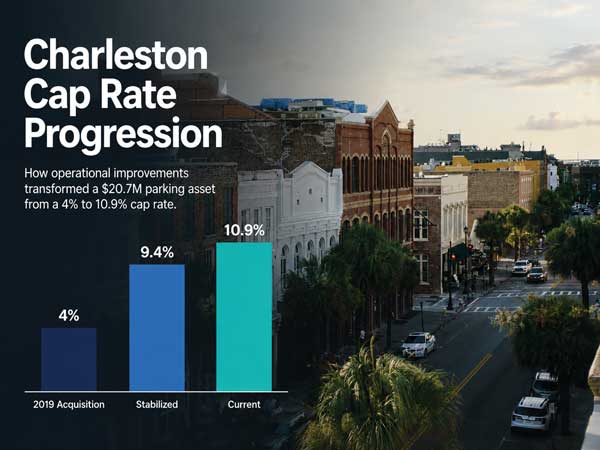
The Charleston project shows what happens when both levers are tuned together. The 152-space asset was acquired in 2019 at a 4% going-in cap rate, reflecting underperforming income. It had been operating with outdated management, inconsistent pricing and minimal visibility.
Courtesy of HAH Parking
The operational changes were modest in cost but meaningful in approach. The developer, Charleston Commercial, invested roughly $50,000 in capital improvements — primarily upgraded signage and lighting along with a set of lot enhancements that included new landscaping, filling potholes, restriping, and improving the lot’s visibility on mapping platforms. The seven separate parcels were consolidated into a single contiguous lot, which streamlined operations and removed the friction of managing multiple legal boundaries. The parking gate and staffed exit, which created lines of traffic and labor cost, were replaced with a digital enforcement system. Transactions and compliance both improved.
The most significant change was pricing. Static rates were replaced with dynamic pricing that adjusted in real time based on occupancy and time of day. The financial impact was substantial. Net operating income grew from $840,000 at acquisition to $2.2 million today. Against the same basis, the going-in cap rate of 4% expanded to a current yield-on-cost of 10.9%. The transformation was achieved with a capital improvement budget of less than $50,000 against an asset value of $20.7 million, far below typical ground-up capex assumptions.
The most consequential outcome was the decision to delay construction. Parking revenue made the existing use more valuable than the planned project. When parking is underwritten properly, the development timeline calculus changes. In the right location, with operational discipline, parking is a performance asset in its own right. More importantly, it can fundamentally reshape the pro forma during the hold period and materially de-risk that hold for both the sponsor and the equity investor. Strong parking revenue covers carry costs, strengthens debt service coverage, supports refinancing optionality and establishes a stabilized income floor that allows the sponsor to time construction or disposition based on market conditions rather than capital pressure.
The Two Levers in Detail
An owner can change only two things to increase parking revenue, and once both are understood, all other operational decisions become simpler. Every improvement to a parking asset fits under one of these levers, and the operators producing the strongest results are the ones improving both at the same time. Both levers are anchored by specific operational practices that determine how well the asset performs in the real world.
Courtesy of HAH Parking
The first lever, number of transactions, is driven by three pillars. Awareness covers whether drivers can find the lot and understand it, which depends on signage and map visibility. Compliance refers to consistent enforcement that drives payment behavior, with the goal being not citation revenue but the change in driver behavior that occurs when a lot becomes predictable. Across most well-managed lots, enforcement revenue itself rarely exceeds 1% to 2% of total gross revenue because the value of enforcement is in the parking passes purchased before a citation is ever issued. Curb appeal covers the physical condition of the lot, including lighting, striping, landscaping and maintenance. A well-managed lot converts at higher rates.
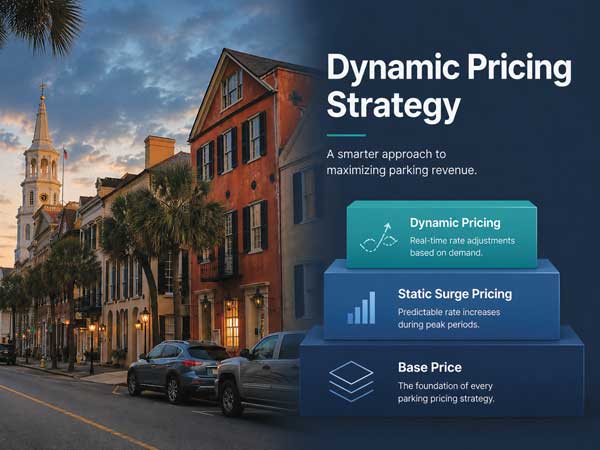
The second lever, revenue per transaction, is driven by layered pricing. The base price is tested annually, typically with 10% to 15% increases that the market absorbs without measurable drops in transaction volume. Static surge pricing applies predictable rate increases during known peak periods such as nights, weekends and holidays. Dynamic pricing, the most advanced layer, adjusts rates in real time based on lot occupancy. As a lot fills, prices rise to capture the additional value of scarce inventory. The three layers work together rather than independently.
Few parking operators implement dynamic pricing well, and owners serious about revenue optimization are searching for partners who can. Boston Consulting Group reports that dynamic pricing can increase revenue 5% to 10% for businesses that adopt it effectively. Airlines, hotels and ride-sharing have done so already; parking has been slower to follow.
The interplay between price and demand is what HAH Parking calls the “transaction paradox.” A full lot is often a failing lot. At full occupancy, the operator cannot capture additional revenue until a space opens, leaving money on the table when demand is strongest. The objective is not maximum occupancy. It is the equilibrium point where availability and price are balanced to capture the highest total revenue across the day.
Josh Schaap, managing director and co-founder of Charleston Commercial, frames it this way: “We underwrote this site as a development play. What we didn’t anticipate was how efficiently the HAH platform could perform during the hold. A management company, a text-to-pay lot and a modest improvement budget, and we were covering land carry and kicking a small yield to investors while the entitlement process ran its course. Parking is now a cornerstone of how we structure acquisitions.”
Charleston, where net operating income nearly tripled, is an example of proper application. Most operators are still measuring success by how full the lot looks. The ones who understand the transaction paradox are measuring it by how efficiently each space is producing revenue, and they are building their pricing, enforcement and inventory management around that distinction.
What Has Changed and What to Do Next
Two trends are reshaping the conversation around parking for commercial real estate professionals. The first is technology. License plate recognition cameras, text-to-pay platforms and cloud-based pricing engines have lowered the operational cost of compliance and enforcement to a fraction of what it was a decade ago. Activities that used to require field staffing now run with minimal head count. That shift has made parking optimization accessible to a much wider universe of owners.
The second trend is more nuanced. Higher interest rates have pushed more deals toward institutional capital, which relies on standardized pro forma models that don’t reflect modern parking economics. For private and middle-market sponsors, this creates a window. The owners who move quickly to underwrite parking as a performance asset can capture returns that institutional underwriting still discounts.
For professionals currently evaluating an acquisition or refinancing, the most useful step is also the simplest: Request a revenue-per-space estimate from an experienced parking operator before finalizing underwriting. The exercise takes days, not weeks, and the resulting number frequently changes the math on the deal. Charleston came to market at a 4% going-in cap rate because its parking had been absorbed into the project rather than underwritten as a performance asset. The 10.9% yield-on-cost that followed is what changed when that assumption was inverted.
In a market where every basis point of yield matters, the parking line on the pro forma is no longer a place to leave money on the table.
Sean Glavin is the chief technology officer at HAH Parking, a parking management technology company based in Charleston, South Carolina. Morgan Hurley is the company’s chief revenue officer.
Where This Approach Does Not WorkThe framework is not universal. Not every lot is a yield-generating asset, and developers who assume otherwise lose money. Location is the single most important factor, and the test is straightforward. The asset needs to sit in a high-density, pedestrian-oriented submarket with established demand generators nearby — typically food and beverage, entertainment, retail and office uses. Lots in infill positions in central business districts perform well. So do lots in dense suburban nodes that function as town center environments. Lots outside that profile generally do not respond to optimization. Single-anchor suburban big-box centers are typically poor candidates. So are lots within walking distance of abundant unmonetized parking inventory. Passive ownership produces plateauing or declining revenue. Lots that perform are run with active asset management discipline: regular pricing tests, consistent enforcement and routine maintenance. Optimization is not a project; it is a habit. |