
Developers can better control long-term insurance expenses by eliminating uncertainty before underwriting begins.
Challenge: Name an industry where the provider knows only 20% to 35% of its ultimate cost when pricing its products or services. Insurance underwriters charge 300% or more of these costs, which is the primary reason insurance costs are perceived as being too high. It is also the basis of why significant rate differentiation exists among carriers.
Understanding how to attract the least costly insurance or risk transfer is essential to commercial real estate operations. For developers, risk mitigation is at the forefront of decision-making, while an underwriter’s No. 1 mandate is to decline risk that threatens profitability, which applies pressure on the premium-to-surplus ratio, the industry’s core measure of underwriting discipline.
Insurers deploy surplus — their shareholder equity — with the same discipline that developers deploy capital. Surplus determines pricing flexibility and capacity to write risk. The developers that achieve the lowest total cost of risk are those that eliminate uncertainty before underwriting begins.
Attracting Underwriter Competition
Following a disciplined approach is far more effective at attracting underwriter competition for a development project than engaging in multibroker bidding, which typically erodes leverage rather than decreasing cost. Developers can take control of a project’s long-term insurance expense by reducing uncertainty and hiring a single broker who understands the firm’s “pure risk” better than the developer’s team does and then creates the submission to underwriters that replaces assumption with evidence.
Construction projects should be designed for insurability, not just compatibility and compliance. Projects can be engineered to attract insurers and reinsurer surplus.
A project’s investment-grade broker submission should include:
Design elements that control severity, not just frequency: Insurance underwriters focus on quantifying risk severity rather than just whether an event will occur. Design examples that control severity include smaller fire divisions, a reduced number of vertical openings, sloped floors in critical areas, and floor-by-floor water shutoff. A submission that includes catastrophic (“Cat”) analytics, including credible average annual loss (AAL) or probable maximum loss (PML) estimates, can reduce rate cushions charged by underwriters.
Material choices: Limit combustibles, use ignition-resistant exteriors, and install roof systems with a track record of verifiable long-term results during real operating conditions. These choices will open up more of the carrier’s capacity at a lower cost and welcome more lenders/investors. Create a more resilient and financeable asset by using noncombustible structural materials and vertical openings. Whenever possible, avoid “stick” or frame structural components. This choice alone will lower annual insurance costs by 30% to 60%. Sprinkler protection that meets NFPA 13 standards represents true suppression. NFPA 13R or NFPA 13D standards are inferior and will not attract low-cost surplus.
Secondary peril data: Rather than just saying “Roof replaced 2022,” the submission should include other data: “Roof replaced 2022 with 60-mil fully adhered TPO, UL 2218 Class 4, FM 1-90 uplift, units include hail guards.” Don’t just say “Flood Zone AE” (a designation by the Federal Emergency Management Agency indicating at least a 1% chance of annual flooding in a given year). A more effective submission might read, “Flood Zone AE. FFE = BFE + 2.3 ft., no critical MEP below grade.” This is more work for the broker, but it provides a better result for the developer.
Documented loss history: Offer details related to causation and include corrective actions that portray a responsible developer that cares about their reputation and brand.
Risk governance: Name an executive accountable for risk management. Provide evidence of contractual risk transfer results, internal property-level audits, and rewarding property managers who exceed standards.
Backup for life-safety features: Examples include two sources of water, reliable municipal response, fire pumps, ESFR (early suppression, fast response), and incipient-stage smoke detection.
Phased construction risk: Many of the largest losses occur during construction. When possible, limit combustibles on-site, and have a disciplined approach to controlling ignition related to hot works (welding, torching, grinding and soldering steel). Likewise, have a clear plan for fire department access.
Day 1 water risk engineering: Examples include smart leak detection/monitoring, multiple shut-off or isolation valves, and the routing of water as far from critical systems as possible.
Safety nets for digital structures: Segment networks for the most essential systems, install life safety platforms with manual overrides, and provide separation between tenant technology and building systems.
Practical Takeaways for Renting Balance Sheets
Think like a reinsurer. By implementing the suggestions above, a developer’s insurance premium (i.e., the cost of renting the insurance company’s surplus) should shrink considerably, making the debt service coverage ratio stronger. Carriers will utilize treaty reinsurance. When a carrier’s treaties do not accept a particular risk, they arrange facultative (ad hoc) reinsurance that will increase the cost by up to 100% of the premium.
Review the insurance broker’s submission in advance of going to market to ensure that it replaces assumption with evidence. Shine a light on the risk story. Provide confirmation of peer review, including engineering reports that directly address underwriters’ concerns.
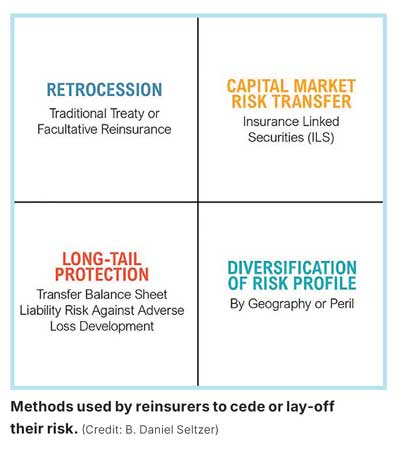
Reinsurance serves as capital protection, enabling carriers to manage volatility and preserve balance sheet strength. The figure on the preceding page shows the four methods that reinsurers deploy to cede or lay-off their risk to provide insurance to the approximately 4,000 insurers in the U.S. property and casualty market.
To summarize, the following practices are most likely to reduce insurance costs for developers:
- Hire one trusted broker who understands entirely how the market operates.
- Execute on what attracts underwriters’ surplus or capacity to your account.
- Design your risk management program such that underwriters are nearly assured of their coverage not being utilized.
B. Daniel Seltzer, CPCU, is the president of ClientSide Risk, LLC, and a member of the 2026 Board of Directors for the Commercial Real Estate Development Association. Contact him at DSeltzer@ClientSideRisk.com.
Other Risks to ConsiderMore recently, two risks have moved from being secondary concerns to balance-sheet-level exposures: energy and artificial intelligence. Numerous projects are being delayed or set aside because utilities cannot support society’s increased power demands. Over the past decade, U.S. energy consumption has been flat, but demand has clearly shifted toward electricity and lower-carbon sources while becoming more efficient on a per capita basis. The result is more electrified buildings and higher dependency risk on power continuity. With utility costs rising equal to housing demands, there is a question of how to assure power availability to support the most explosive need — artificial intelligence. The most material financial exposure for real estate developers is not the risk that AI might fail; it is the possibility that AI is being relied upon without sufficient human oversight. When left unchecked, AI will replicate the same error at scale, transforming what would otherwise be isolated issues into systematic problems. In real life, this could result in contract deficiencies, design and construction errors, flawed underwriting, regulatory violations and pricing inaccuracies. It is important to note that use of AI for tenant screening, investor communications, financial decision-making or the provision of recommendations is not a legal defense for subsequent errors. Developers remain fully liable. Such missteps give rise to professional liability exposure, fair housing claims, and director and officer allegations, usually stemming from inadequate oversight or overreliance on automated outputs. There is also risk to proprietary value. Without proper vetting, team members may inadvertently include sensitive strategies, models, tenant information and development plans in AI systems, resulting in the threat of litigation, loss of investor relations and negative brand perception. Cybersecurity is another growing area of concern. This past April, PwC reported that 31% of Fortune 1000 C-suite executives ranked cyberattacks as the No. 1 risk presenting “serious” challenges to their organization. Real estate development, defined more than ever by speed, complexity and large capital flows, has become an increasingly attractive target for sophisticated threat actors. These attacks do not exploit technological weaknesses alone. They also target human behavior, deceiving employees into authorizing fraudulent payments or disclosing sensitive information. Cyber experts and insurance claims executives know that even well-designed financial controls are circumvented when trust and urgency are manipulated. The growing use of AI-enabled tools is increasing the scale and effectiveness of cybercriminals. To mitigate this risk, real estate organizations integrate internal controls with correctly structured cyber and crime insurance. Underwriters now place strong emphasis on governance, payment protocols and continual employee training when evaluating risk and pricing the cost of their surplus. It is advisable for developers to engage in best-in-class risk preparedness before applying for any insurance. |