A developer’s road map to federal land acquisition, permitting and the new fast-track process.
The American Southwest is expanding at a pace that outstrips its capacity to house its people. The region already confronts a significant housing deficit, and over the next 15 years it is projected to absorb 15 million new residents.
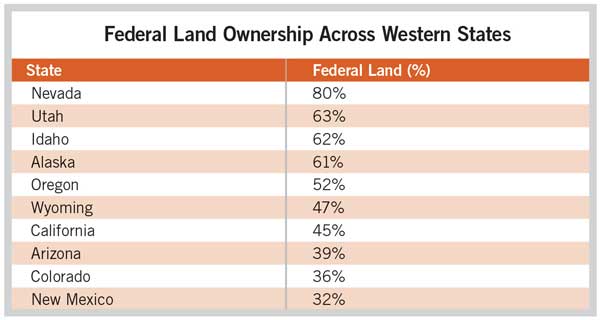
For developers, the central paradox is that the land exists, but it is largely inaccessible. Nevada, where 80% of the land is federally owned, exemplifies the problem, with private developers competing for a fraction of the state’s acreage in one of the nation’s fastest-growing markets. That constraint is regional across the West, with federal ownership in other states ranging from 32% in New Mexico to 63% in Utah.
At the current rate, only one-tenth of 1% of federally owned land is sold each year. Pair that with a national shortage of 7.1 million affordable rental homes, which are disproportionately concentrated in the Southwest. Without a significant increase in developable land, affordability will remain beyond reach for millions of Americans.
Last year produced the most consequential set of legal and policy changes to federal land development in a generation. What follows is a practitioner’s road map through this evolving landscape.
Understanding the Regulatory Framework
First, it helps to understand the statutory framework that governs federal land disposition.
FLPMA: The Gatekeeper
Every federal land transaction begins with the Federal Land Policy and Management Act of 1976. FLPMA establishes a presumption of retention: Public lands remain in federal ownership unless disposal serves the national interest. Any parcel identified for sale must appear in a Bureau of Land Management (BLM) resource management plan and satisfy at least one of three statutory criteria:
- The tract is difficult or uneconomic for BLM to manage.
- It is no longer required for federal purposes.
- Disposal serves important public objectives such as community expansion or economic development.
For practitioners, the takeaway is to review the applicable resource management plan before committing capital. If the target parcel is not identified for disposal, a plan amendment will be required. That process, which involves public comment, interagency coordination and review of the National Environmental Policy Act (NEPA), routinely extends across multiple years.
NEPA: The Procedural Bottleneck
NEPA requires federal agencies to assess environmental impacts before authorizing land sales, leases or other dispositions. Depending on the significance of the proposed action, this entails preparing an environmental assessment or a full environmental impact statement.
Between 2010 and 2018, the average environmental impact statement took four-and-a-half years to complete. For developers, those years translate into carrying costs, financing risk and missed market windows. NEPA also invites litigation under the Administrative Procedure Act, a liability that, until recently, could add years of additional delay.
The 2025 Landscape: What Changed
In March 2025, the Department of Housing and Urban Development (HUD) and the Department of the Interior announced a Joint Task Force on Federal Land for Housing. The task force is charged with inventorying underutilized federal properties suitable for residential development and streamlining transfer processes, signaling that housing is being treated as a legitimate public objective under FLPMA’s disposal criteria. Developers that cultivate relationships with local governments and housing authorities positioned to receive federal land transfers will be well placed to participate.
The One Big Beautiful Bill Act (OBBBA), signed into law July 4, 2025, introduced the most consequential reform to NEPA permitting in the statute’s 55-year history. Section 60026 creates a fee-based expedited review process through which a project sponsor may pay the Council on Environmental Quality (CEQ) a fee equal to 125% of the anticipated cost to prepare or supervise an environmental assessment or environmental impact statement. In return, the lead agency must complete the environmental assessment within 180 days or the environmental impact statement within one year.
To invoke the process, a sponsor submits a project description and declaration to CEQ indicating whether the sponsor intends to prepare the environmental document itself under NEPA Section 107(f). CEQ then has 15 days to notify the sponsor of the required fee.
Three open issues bear monitoring. First, the statute prescribes no remedy if the agency misses the expedited deadline. Second, CEQ has not yet published guidance on fee calculation methodology. Third, compressed timelines may strain resource-constrained agencies, potentially increasing litigation risk if reviews appear deficient. Notably, OBBBA also imposes a 120-day statute of limitations on NEPA challenges and requires a showing of irreparable harm for injunctive relief, materially reducing post-approval litigation exposure.
Pathways to Federal Land: A Developer’s Tool Kit
Developers wishing to access federal land can explore several options.
Direct sale under FLPMA Section 203: Where a parcel is already identified for disposal in a BLM resource management plan, acquisition proceeds through the Section 203 sale process at not less than fair market value. The process entails a Notice of Realty Action in the Federal Register, a public comment period, NEPA review and title examination. Note that FLPMA sales typically reserve the mineral estate to the United States, so subsurface mineral reservations warrant careful due diligence on title and development feasibility.
The Recreation and Public Purposes Act: The R&PP Act authorizes BLM to convey public lands at less than fair market value, or at no cost, to states, political subdivisions and nonprofits for public purposes, including affordable housing. Under the Southern Nevada Public Land Management Act (SNPLMA), R&PP conveyances have produced more than 650 affordable rental units on 25 acres of former federal land. Developers pursuing affordable projects should structure partnerships with eligible public entities to leverage this below-market pathway.
SNPLMA: Enacted in 1998, SNPLMA authorizes BLM to sell public land within a designated boundary around Las Vegas through modified competitive auctions. Since enactment, SNPLMA has generated over $4 billion in land sale revenue and facilitated the development of master-planned communities, schools and municipal infrastructure. Developers interested in Nevada should monitor BLM Nevada realty action notices and cultivate relationships with the local governments that nominate parcels for sale.
Federal land exchanges: FLPMA Section 206 authorizes BLM to exchange federal lands for nonfederal lands of equal value within the same state. This mechanism can benefit developers who hold parcels of conservation value. Exchanges require dual appraisals, a public interest determination and NEPA review. While complex, they offer a pathway to specific federal parcels not otherwise available.
Financing the Build: OBBBA Tax Provisions
OBBBA delivers the most significant expansion of affordable housing tax incentives in more than two decades. Developers pursuing housing on federal land should evaluate four provisions in particular:
Expansion of the low-income housing tax credit (LIHTC): Each state’s annual LIHTC allocation authority increased permanently by 12%, effective Jan. 1, 2026. The private activity bond threshold for 4% credits dropped from 50% to 25% of aggregate basis, freeing bond capacity for additional projects.
Permanent opportunity zones: The qualified opportunity zones program is now permanent, with rolling 10-year zone designations starting this July. The changes also ushered in a new category of qualified rural opportunity funds offering a 30% basis step-up for five-year investments.
100% bonus depreciation: This provision was permanently restored for qualified property placed in service after Jan. 19, 2025, improving investor yield and reducing after-tax construction costs.
Permanent New Markets Tax Credits: This provision was extended at $5 billion in annual allocation authority, providing long-term financing predictability for mixed-use projects pairing housing with community facilities.
Practical Steps for Developers
Conduct early reconnaissance. Identify target parcels using BLM’s geographic information system data and publicly available land records. Review the applicable resource management plan to determine disposal status. Within SNPLMA boundaries, review auction schedules and local government nomination processes.
Engage local government partners. Federal land dispositions routinely require local government involvement through parcel nominations, R&PP applications or task force referrals. Establishing relationships with planning departments, housing authorities and elected officials is essential.
Evaluate the NEPA pathway. Determine early whether the action requires an environmental assessment or environmental impact statement or if it qualifies for a categorical exclusion. If an assessment or impact statement is needed, evaluate the OBBBA fast-track option, budget for the 125% fee, and integrate expedited timelines into financing and construction schedules.
Commission preliminary environmental and cultural surveys. Section 7 of the Endangered Species Act and Section 106 of the National Historic Preservation Act impose consultation requirements that run concurrently with NEPA. Preliminary biological and cultural resource assessments can identify potential issues before the formal process begins.
Assemble the right team. Federal land transactions sit at the intersection of property, environmental and tax law. Having counsel experienced in FLPMA and NEPA is essential. For deals leveraging LIHTC, opportunity zones or New Markets Tax Credits, specialized tax counsel is equally critical.
Plan for infrastructure. Federal parcels frequently lack roads, water, sewer and electrical service. Engage with local utilities and municipal offices early to evaluate capacity and negotiate cost-sharing arrangements.
Monitor the regulatory landscape. With individual agencies now promulgating their own NEPA procedures, subscribe to Federal Register notices for BLM, Department of the Interior and CEQ actions. Participate in comment periods to shape outcomes favorable to development.
The New Viability of Federal Land Development
The convergence of legislative, judicial and executive action in 2025 has created the most favorable conditions for federal land development in a generation. There now exists both procedural and financial architecture to make federal land development projects viable. Developers that master the framework, build the right partnerships, and plan for both infrastructure deficits and regulatory contingencies will position themselves to come out ahead.
David L. Edelblute, Esq., is a shareholder at Howard & Howard Attorneys PLLC, where he advises developers, investors and public entities on federal land transactions, environmental permitting, entitlements and complex commercial litigation.