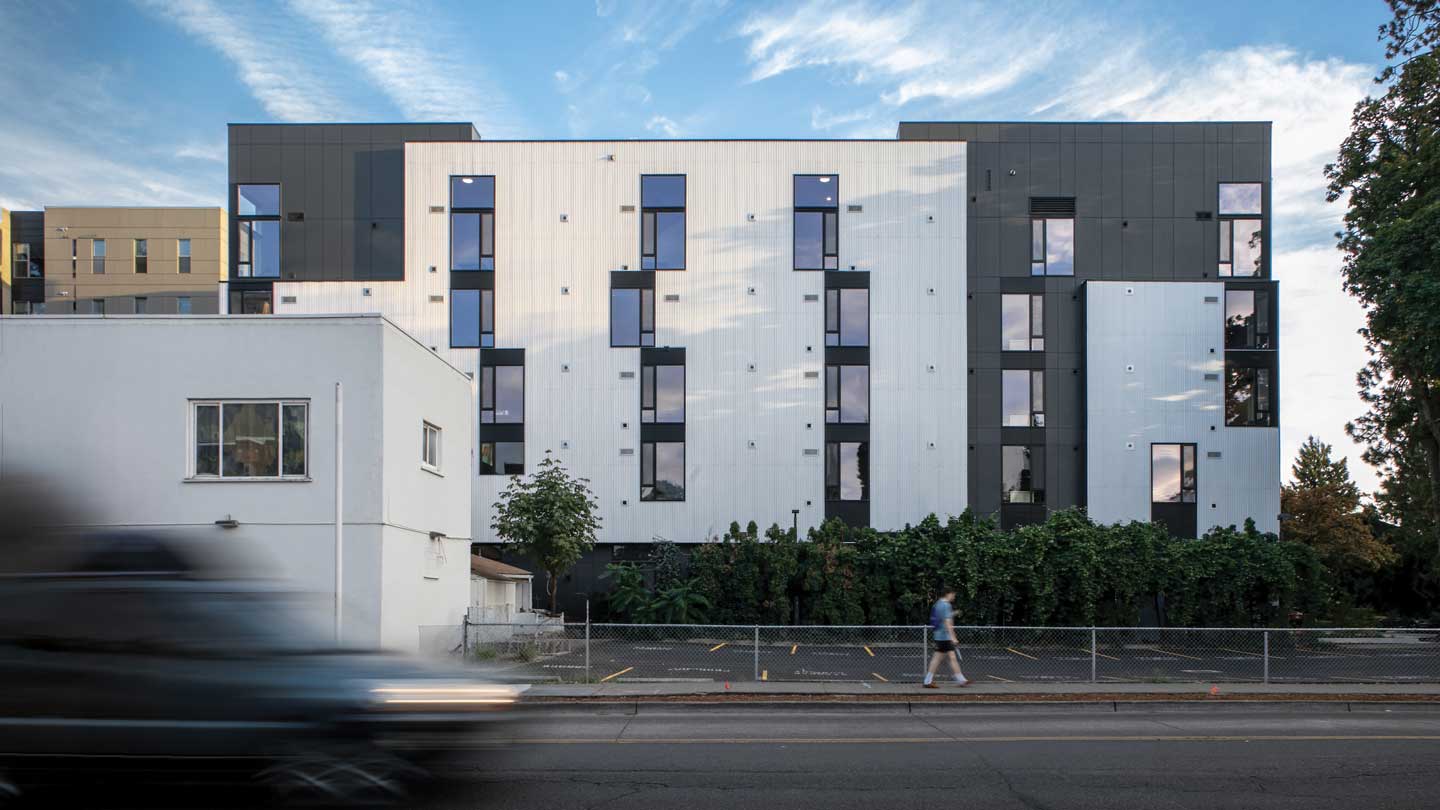
The elimination of parking minimums in Eugene, Oregon, opened the door for development of new student housing on a former single-family lot.
A deteriorating duplex on an 8,763-square-foot lot in Eugene, Oregon, didn’t look like a 65-unit development site. It was long and narrow, zoned for single-family use and priced accordingly. But single-family lots are undervalued in most markets. With disciplined design informed by construction economics and local regulations, they can become profitable density projects.
When developer Sean Barnes, founder of Eastmark Capital Group, and property owner Diamond Parking Corporation — which had held the site since acquiring it for $1.05 million in 2015 — brought the site to Trek Architecture, what emerged was proof of concept for that premise. Eighteen months later, Ferry Street Flats opened — a five-story, 65-unit student housing building that quickly reached full occupancy. The project required a developer who recognized opportunity in a policy shift and an architect that could turn the opportunity into a design optimized for constructability.
Parking Reform Ushers in a New Vision
The duplex site presented constraints that would lead most developers to walk away. Barnes saw something different.
Oregon’s Climate-Friendly and Equitable Communities rules, adopted in mid-2022, required cities to reform parking minimums as part of efforts to reduce greenhouse gas emissions. Eugene responded by eliminating minimum parking requirements entirely, first in transit corridors in 2023, then citywide. For lots with tight footprints near the University of Oregon campus, that policy shift changed the math. Structured parking would have consumed the project budget and eaten buildable area for Ferry Street Flats. Without parking requirements, capital went to construction, and every square foot went toward rentable units.
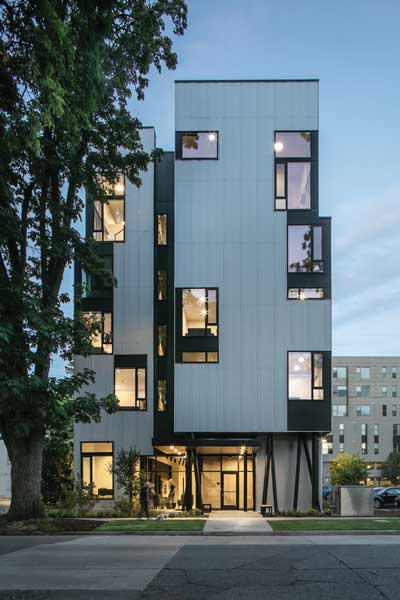
The building entry at dusk. Courtesy of Trek Architecture
Early massing studies confirmed what the geometry suggested: The long, narrow parcel pushed toward an efficient linear form. The site’s zoning already permitted the density Barnes had in mind, and a neighborhood that had long absorbed student-oriented development offered no resistance.
“At Eastmark, we’ve always viewed unconventional sites as opportunities,” Barnes said. “Proximity to campus and transit made the density viable, and once we started diagramming massing, it became clear we could deliver far more than the single-family assumptions embedded in the original lot. Others saw width as a constraint; we saw a well-positioned corridor ready for thoughtful density.”
The Unit Variety Thesis
Most student housing buildings standardize one or two unit types because identical units simplify construction. But standardization forces every prospective tenant into the same box, competing on price alone when preferences don’t match.
“Students come with very different budgets, living styles and expectations,” Barnes said. “Variety lets us create a true affordability spectrum, from efficient micro-units to premium lofts, so more students can find a home that fits both their wallet and lifestyle.” Rents at Ferry Street Flats range from $1,225 to $1,590 per month — or $3.45 to $3.75 per square foot — depending on unit type and floor.
National student housing occupancy sits at 93%, with 1.8 times more beds absorbed than delivered in 2024. In an undersupplied market near a major university, there was room to try something different with Ferry Street Flats.
Barnes’ theory married market breadth with an understanding of his target residents. Student leasing cycles move fast, and prospective tenants often have only weeks to choose housing. More options improve the odds of finding the right fit. Over time, a mixed portfolio also adapts as preferences shift.
Turning that theory into a feasible design was Trek’s challenge. Ten distinct unit configurations across 65 units is an unusually high ratio for any building. Trek had to create varied living experiences while standardizing what contractors would build.
Creating Variation With Intentional Design Solutions
Trek’s approach: Vary layout while standardizing systems. Tenants experience variety; contractors build consistency. The same logic applies wherever unit diversity is a goal.
Facade: A push-pull envelope strategy shifts the metal-clad form in 2-foot increments. Some portions advance while others recede, creating units ranging from 14- to 16-feet wide and 18- to 20-feet deep. Unit orientation alternates as well. Some run front to back and others side to side, producing different entry experiences without structural complexity.
Carved volumes clad in black fiber-cement panels punctuate the facade, creating rhythm in dialogue with surrounding historic homes. The goal wasn’t to mimic a previous era but to complement the district’s character while creating something unapologetically of its time.
Ceiling height: Type 3 construction uses fire-treated wood framing at a fraction of the cost of steel or concrete, but it tops out at five stories under most codes. Zoning would have allowed additional height, but going higher would have required a different construction type and blown the project budget. The economics set the story count.
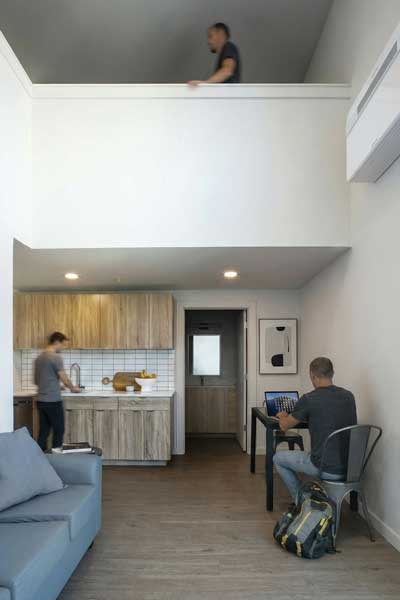
A lofted unit with bedroom tucked above the kitchenette. Courtesy of Trek Architecture
A 75-foot height limit determined where lofts could go. Only two floors could accommodate the additional ceiling height required for lofted bedrooms. Floors one and five emerged as natural choices: The first floor offered convenience and accessibility, while the fifth floor captured premium views. Both floors also have setbacks at the building’s edges where lofted units could extend vertically to recover livable space that a standard layout would lose. Middle floors remain standard flats. Rather than forcing lofts throughout, the constraint created natural differentiation.
Preserving privacy: Beyond lofts, the team developed a “studio plus” configuration. In these units, a closable door creates a semi-private sleeping area that feels like a separate bedroom while meeting code for a studio. The distinction matters to renters who want privacy without paying for a true one-bedroom.
Flat units run from 326 to 342 square feet; lofted units span 420 to 490 square feet. At that size range, the spaces demanded strategies to feel larger. European-manufactured vinyl windows, often as wide and tall as the rooms themselves, proved critical. At this scale, extensive glass can cost less than framed wall assemblies.
Strategic standardization and shared spaces: All 10 configurations share identical bathrooms, but kitchens vary by unit type in ways that reflect both budget and practical use. Flat units include a kitchenette with a mini fridge and no cooking appliance. Lofted units step up to full-size refrigerators. Across all unit types, variation comes through layout and spatial experience, not finishes or fixtures.
Full kitchens and laundry appear on alternating floors rather than in every unit, reducing plumbing runs and mechanical complexity. Shared amenities trade individual unit completeness for lower per unit costs, a trade-off that works when location and price outweigh in-unit convenience.
Fast-track Execution
Design started in January 2024. Foundation permits were submitted by April and superstructure permits in May, with construction beginning in July. The building was completed the following July and fully leased within a few months. That 18-month timeline — from first sketch to certificate of occupancy — required close coordination between developer and design team, along with early regulatory engagement.
“The urgency was driven almost entirely by the student leasing cycle,” Barnes explained. “Missing the window can mean losing an entire year of absorption. That timing pressure made speed a strategic advantage, not a gamble.”
Barnes had worked with Trek on previous projects, and that history made the aggressive timeline possible. Fast-tracking meant submitting civil and foundation packages separately while building design continued. Site work began before the full building permit was issued, compressing the schedule by months. That approach requires trust: confidence that design will finish on time, that direction won’t change and that both sides will absorb surprises without renegotiating terms.
Jurisdictions interpret Type 3 construction differently, and Eugene had issued specific memos on fire-rated assemblies. Early engagement with the city prevented surprises during construction. So did the flexibility to absorb changes. When the developer requested a mid-construction shift from tubs to showers — a change with accessibility implications — the team adapted without derailing the schedule.
Keys to the Project’s Success
At a total project cost of $8.5 million, Ferry Street Flats opened fully furnished on Aug. 15, 2025, with 75% of units already leased. Full occupancy was reached by Sept. 24, just 40 days after opening and five days before the University of Oregon’s fall term began.
Three factors contributed to the project’s overall success:
- A policy shift that changed site economics before land prices adjusted.
- Proximity to campus that supported car-light living.
- A partnership that could move at the speed the market required.
Developers seeking similar opportunities should track policy at the district level while building relationships with design partners that can translate opportunity into permitted plans.
The unit variety thesis extends beyond student housing. Any market where renters segment by budget, lifestyle or preference rewards buildings that offer options. The key is designing variation into layout rather than finishes while keeping construction standardized.
Ferry Street Flats put 65 units where a duplex once stood. The next opportunity is sitting on someone else’s undervalued lot, waiting for a developer who knows the right questions to ask.
Evan Verduin, AIA, is the founding principal and project director at Trek Architecture, a design-forward studio with offices in Spokane, Washington, and Jackson, Wyoming.
When Does Parking Reform Unlock Density?Parking reform unlocked Ferry Street Flats, but policy alone doesn’t guarantee opportunity. Two questions determine whether a constrained site can support density: Has a policy shift made it financially viable? Eugene’s elimination of parking minimums removed a cost that would have killed the project. Structured parking on a tight lot consumes budget and buildable area. Over 3,000 cities worldwide have adopted parking reforms, according to the Parking Reform Network, though only about 20% have eliminated minimums citywide. Most reform is district-specific. A 2024 Colorado study found parking reform increased transit-oriented development opportunities by 71% — more than any other single policy evaluated. Does the location support car-light living? Parking savings only translate to buildable area when residents can realistically live without cars. Student housing within half a mile of campus sells for an average of $119,000 per bed, according to Berkadia’s 2025 U.S. Student Housing Market Report, a 54% premium that explains why near-campus sites pencil and distant ones don’t. When the answers to both these questions are yes, a site that others dismiss may be exactly where density belongs. |