Those who capture the most value from transit-oriented development execute well ahead of the ribbon cutting for new service.
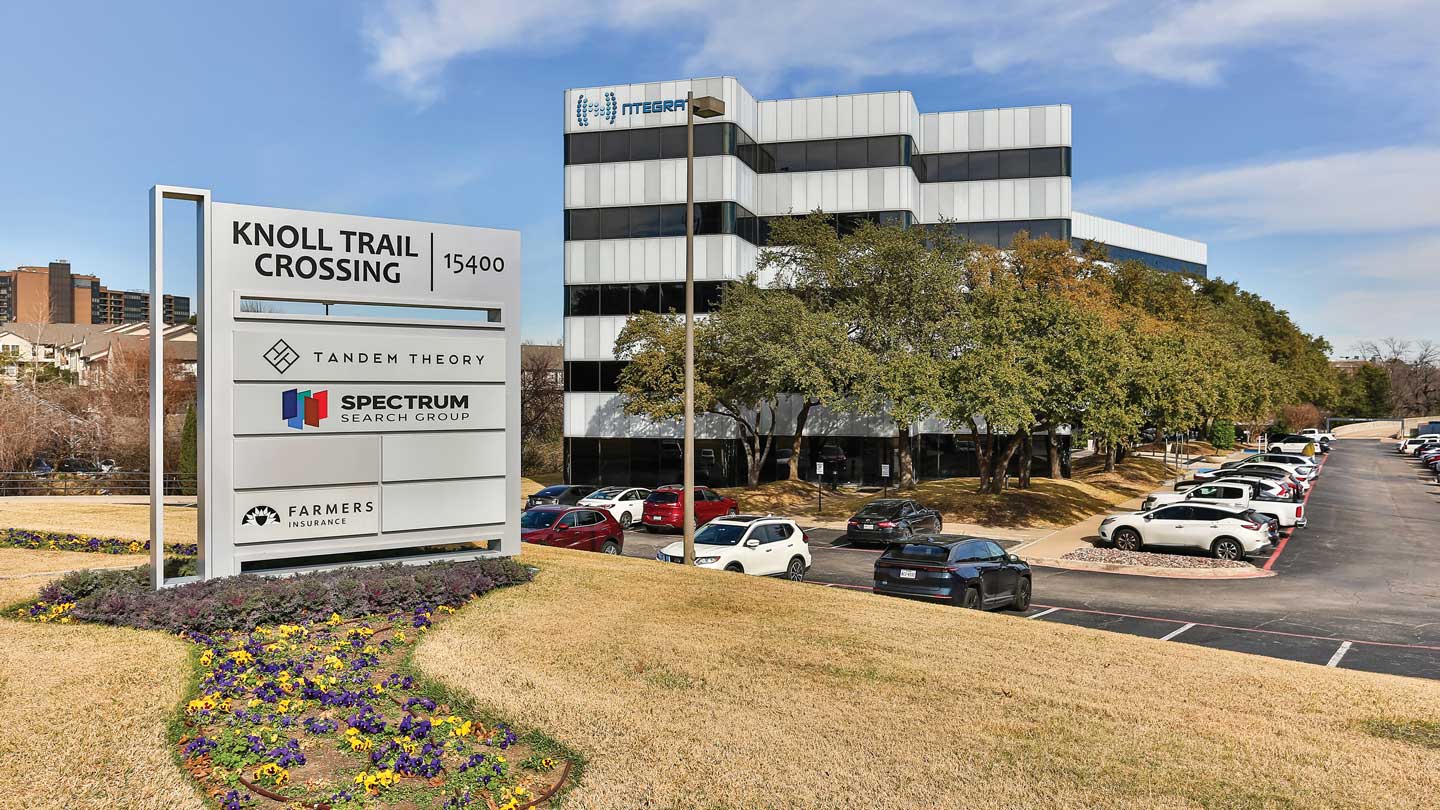
Knoll Trail Crossing in North Dallas is the only commercial office property along DART’s newly opened Silver Line with a station at its front door. The platform for the regional rail service is less than a one-minute walk from the office building’s lobby.
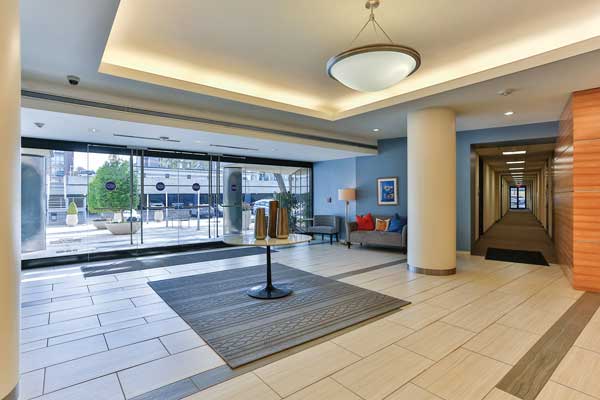
The walk from Knoll Trail Crossing’s lobby to Knoll Trail Station takes less than a minute. Courtesy of Prescott Group
That physical fact required years of deliberate groundwork to monetize, and it illustrates the central challenge of transit-oriented development (TOD): Proximity does not automatically confer value. Value is created through capital sequencing, operational integration, and tenant positioning that anticipates how rail reshapes space utilization expectations before those expectations reach asking rents. Adding further complexity are community perception and experience with the transit agency and its execution of TODs.
Identifying an Asset Before Transit Value Is Priced In
Prescott Group, a diversified real estate investment firm headquartered in Dallas, acquired Knoll Trail Crossing, a five-story, 96,509-square-foot office building, in 2019 — prior to completion of the Dallas Area Rapid Transit (DART) Silver Line and well before Knoll Trail Station’s impact on the surrounding submarket was legible to most investors. Prescott’s familiarity with DART’s development patterns gave the firm a meaningful edge. The team had previously owned 6060 North Central Expressway, a Class A office adjacent to the Mockingbird Station DART stop, and carried forward a firsthand understanding of how TOD could lift asset value. At that stage, Knoll Trail Crossing was priced largely as a conventional Dallas North Tollway corridor office building — a product type facing well-documented headwinds in the local market.
The acquisition was built on two overlapping bets: that the Silver Line would complete on a timeline aligned with a planned capital improvement cycle, and that the station’s specific location — directly adjacent to the property — would create a differentiation unparalleled elsewhere along the line.
Not all transit-adjacent assets are equal. Properties within a one-minute walk of a platform command meaningfully different rent premiums than those a five-minute walk away. Research from the University of North Texas has found that developments within walking distance of light rail stations capture 12.6% higher commercial rents and 10% higher residential rents than comparable properties farther from transit. The first analytical step for any developer evaluating assets near planned rail is station proximity mapping, with underwriting that stress-tests rent premium assumptions rather than accepts them as given.
Executing Capital Improvements Ahead of Occupancy Demand
Following acquisition, Prescott Group and its equity partners committed several million dollars in capital upgrades during 2020 and 2021. This was a deliberate decision to renovate during a period of depressed leasing activity rather than wait for market recovery. The scope of improvements included:
- Lobby modernization designed to signal institutional quality to tenants evaluating the building for the first time via rail, not just by car.
- Move-in ready spec suites to compress the time between prospect interest and lease execution — a critical advantage in a submarket where tenants began touring more frequently as transit became operational.
- A redesigned tenant lounge and updated conference center to align the building’s amenity profile with the urban walkability narrative the transit station enables.
- Exterior and landscaping upgrades to reinforce the pedestrian experience between the Silver Line platform and building entrance.
- Redesigned drop-off zones along Knoll Trail Drive to improve circulation during peak hours for both transit users and drivers.
The acquisition was structured through Prescott’s strategy funds and a long-standing institutional banking relationship maintained across multiple Dallas-area transactions, allowing the capital stack to be assembled quickly and on favorable terms when broader office lending had tightened. The Silver Line itself was funded through federal grants, state allocations and local tax revenues, a public investment that effectively de-risked the private capital committed by owners who had positioned ahead of the opening.
Renovating during a downturn is counterintuitive but strategically sound when a fixed transit opening provides a hard timeline. The goal is a finished, lease-ready product the day the station opens — not construction that begins once leasing momentum is already visible to competitors.
Pursuing Operational Integration, Not Just Physical Proximity
Physical closeness to a transit station is a starting point. Operational integration is what converts proximity into a durable competitive advantage.
At Knoll Trail Crossing, that integration took several concrete forms, including:
- Rooftop garage access coordinated with DART for Silver Line operations and emergency vehicles, with eight to 10 dedicated spaces allocated for Silver Line drop-off operations, while Knoll Trail tenants retain their on-site parking for use when commuting or traveling via the line to Dallas Fort Worth (DFW) International Airport.
- Pedestrian infrastructure aligned with both platform access from Knoll Trail Drive and the Cotton Belt Regional Trail, extending
That last transaction carries outsized strategic value. It embeds an institutional tenant with long-term operational ties to the station and signals to prospective tenants that this is permanent infrastructure rather than a stop that could be deprioritized in a future funding cycle.
All these actions were the product of deliberate, early engagement with DART that began well before the station opened. Transit agencies can be far more than infrastructure neighbors; when engaged as long-term partners, they become institutional anchors whose presence adds value that no amount of marketing can replicate.
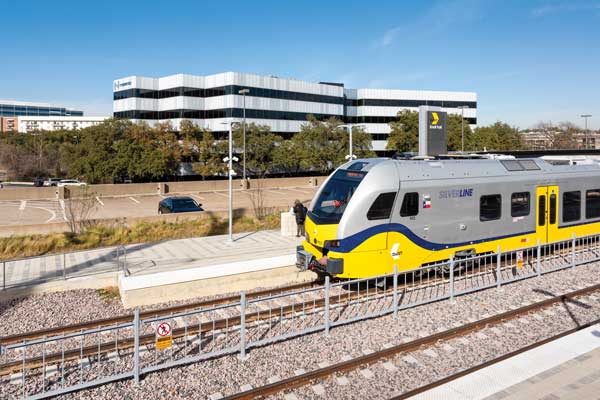
Prescott Group acquired Knoll Trail Crossing in 2019, wagering that the office property’s location directly adjacent to a future DART station would create differentiation unmatched elsewhere along the Silver Line. Courtesy of Prescott Group
Repositioning the Tenant Value Proposition Around Mobility
The Silver Line provides a direct rail connection to DFW International Airport in approximately 35 minutes from Knoll Trail Station. For tenants with mobile workforces, visiting clients or employees distributed across the region, that figure offers reliability — unaffected by road congestion and at no parking cost to the employer — representing a meaningful operational advantage.
Prescott’s leasing strategy shifted to lead with that advantage explicitly. Rather than positioning Knoll Trail Crossing as a Dallas North Tollway corridor office building with transit nearby, the asset was reframed as a multimodal workplace where employees can reach the airport predictably and access other DART lines across the region — all without entering a car. The framing resonated most strongly with professional services firms with frequent client travel, medical office users, and regional operations centers whose employees commute from multiple directions across North Texas.
Transit does not sell itself. Leasing teams should convert travel times and connectivity maps into concrete operational value for the tenant types they are pursuing. A 35-minute airport connection is more valuable when applied to a real scenario that a decision-maker can picture, such as desk to departure gate in under an hour, without the unpredictability of road congestion.
Tracking Leading Indicators and Adjusting Quickly
Since Silver Line ridership commenced in October 2025, early outcomes at Knoll Trail Crossing have validated the strategy ahead of the original timeline. Tenant and prospect feedback on the line’s benefits for business travel has been consistently positive, touring activity has increased, prospect pools have deepened, and tenants that previously filtered out of the Tollway corridor have reengaged.
The asset is also benefiting from a broader market shift favorable to well-positioned office properties:
- Lenders that pulled back from the office sector are returning with more competitive terms.
- Employers are reestablishing in-office expectations, increasing demand for locations that reduce commute friction.
- Business travel has rebounded, heightening the value of reliable airport access.
TOD is a multiyear play, but leading indicators — touring velocity, inbound inquiry volume, prospect mix — move faster than rents. Tracking those metrics in the first 12 months after a transit opening provides the data needed to adjust capital deployment and leasing strategy before the full rent cycle turns.
The Broader Opportunity
Knoll Trail Crossing is one data point, but the pattern is replicable. Across the United States, transit agencies are expanding rail into suburban corridors built around automobile dependency. In nearly every case, an acquisition window opens years before service begins, then closes quickly once the market prices in the new connectivity. The developers that capture the most value will be those that treat transit adjacency as a fundamental input to capital planning and leasing strategy — and that are already executing when the ribbon is cut.
Jud Pankey is CEO of Prescott Group. Will Guerriero is Prescott Group’s portfolio manager. Natalie Johnson is the account executive for Ashlar Projects.
Best Practices for Developers Pursuing TODEngage the transit agency as a strategic partner, not just a neighbor. Starting conversations two to three years before anticipated opening creates the lead time needed to structure agreements that benefit both parties. That groundwork can produce an integration that sets a property apart from every other building along the line. Underwrite against a range of opening scenarios. Infrastructure timelines are subject to variables that are rarely fully in view at acquisition. A capital plan stress-tested across multiple opening windows avoids overextending on renovation spend ahead of a delayed catalyst. Treat the pedestrian path from platform to lobby as prime real estate. That 60-second walk is the first physical experience a prospective tenant has of the building. Signage, landscaping and lighting along that route should be intentional from day one. They are among the highest-return investments in the entire project. |
The Public Funding EquationThe Silver Line was funded through a layered combination of federal grants, state transportation allocations and local tax revenues collected within the DART service area, reflecting how most modern U.S. rail expansions are financed. Federal contributions through programs like the Federal Transit Administration’s Capital Investment Grants typically cover a significant share of eligible project costs, with state and local sources covering the remainder. For private owners adjacent to new rail, the implication is significant: The infrastructure investment driving asset appreciation has largely been paid for by public sources. The developer’s job is to move early enough to acquire at pre-transit pricing, execute improvements aligned with the opening timeline, and capture the rent premium the public investment enables. That dynamic underscores why station selection is the single-highest-leverage decision in the entire process. Once the market recognizes which stops will anchor value, the window closes fast. |