Land, power and policy are repositioning the Midwest as a CRE hub, while adaptive reuse and redevelopment are revitalizing Pennsylvania’s Lehigh Valley.
The old steel-and-smokestack economy isn’t coming back. Instead, the Rust Belt is being remade.
Across the region, former steel sites, freight corridors and aging industrial districts are attracting a new wave of advanced manufacturing, logistics, data centers and mixed-use development. As coastal markets run into land shortages, power constraints and pricing fatigue, the Midwest’s infrastructure scale, labor depth and relative room to grow are giving it a new strategic edge.
Hyperscalers are moving beyond their traditional strongholds in search of new sites across the region. Manufacturing investment tied to federal incentives is clustering near legacy industrial corridors, and institutional capital is following. In the process, the Midwest is reasserting itself as one of the country’s most important centers of industrial and data infrastructure growth.
Reinvention, Not Revival
“The Midwest went through a truly gut-wrenching restructuring as core manufacturing declined,” said Jeff Adler, vice president of Yardi Matrix, a commercial real estate data and research company. “The entire region was effectively gutted over several decades. But it survived, and now the foundation is in place for steady growth. I’m very bullish on the Midwest, but investors have to be clear-eyed. This isn’t going to be explosive growth. It’s more likely to be sustained growth — 3% or 4% a year. And over time, that can be very powerful.”
That steadier, more durable growth is central to the Midwest’s appeal, according to Michael Copella, senior managing director of CBRE’s advisory services in the eastern Midwest region. He said the Midwest’s corporate real estate market is building on an existing base of skilled labor and manufacturing expertise. In addition, many Midwestern states have strengthened incentive packages for major manufacturing and industrial projects, increasing their competitiveness for job-creating investment.
The comeback is far from uniform, however. Some markets have rebounded strongly, moving from legacy manufacturing into a broader mix of industries, while others have struggled to reimagine themselves, said Tony Barranco, northern division president of Ryan Companies, the Minneapolis-based developer with deep roots in the region.
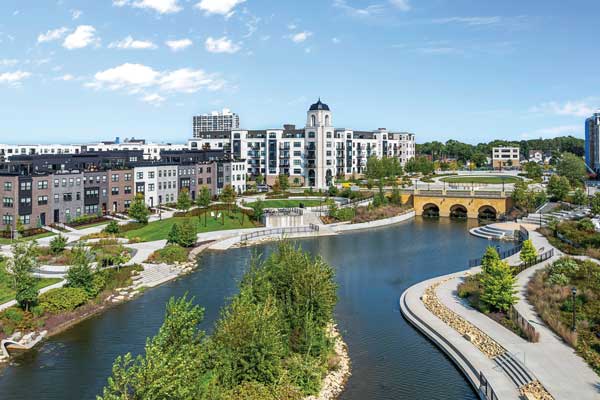
Ryan Companies redeveloped a former Ford Motor Company plant in St. Paul, Minnesota, into Highland Bridge, a 122-acre mixed-use community with 3,800 new residences, office, retail and green space. ToMorrow's Media
“Cities like Columbus, Des Moines and Indianapolis have seen solid growth, while some population centers, including Detroit and Chicago, have been more stagnant,” Barranco said. “The Midwest is known for its well-trained and reliable workforce, and while some markets have performed better than others, the Midwest has largely avoided boom-and-bust real estate cycles. This has allowed construction to remain steady and real estate investment returns to be more durable.”
“The Midwest has several advantages over the coastal markets, especially when it comes to industrial, manufacturing and data center projects,” Copella said. “For those projects, space, power and infrastructure are more readily available, with the overall real estate and occupancy costs being lower than on the coasts. In addition, the Midwest’s stable climate, abundant flat ground and natural resources, like the Great Lakes, [plus] its overall central location, which give it proximity to a high percentage of the U.S. population, make it a strategic alternative.”
Advanced Manufacturing, Not Just Warehousing
For all the attention paid to logistics and warehouse construction, the Midwest opportunity is increasingly about something more valuable: advanced manufacturing, critical components, electrification, chip-adjacent production and digital infrastructure.
Adler said the Midwest is benefiting from a manufacturing shift driven by industrial policy, reshoring and digital infrastructure demand. “The Midwest has intellectual capacity, it has resources like power and water, and it has the workforce base,” he said. “That puts it in a very good position to take advantage of these trends.”
That shift is changing the character of industrial development. Seth Martindale, vice chairman at CBRE, said: “We see a definite trend of companies leaning harder toward automation, knowing that labor access is currently difficult and likely to continue that way. According to CBRE, 11.4% of bulk leasing activity [100,000 square feet or more] in the Midwest was for manufacturing in 2025. This figure is down slightly from 2024, when it was 14.4%. … This was due to a wave of 3PL [third-party logistics] deals in 2025 that lowered the share somewhat. In 2021, it was 9.6%.”
Buildings are changing too. Brian Kombrink, senior vice president of industrial at Ryan Companies, said modern Midwest industrial projects are trending smaller, are more specialized and feature more automation than the large, less complex distribution centers built over the past decade.
“Instead of planning one massive distribution center, developers are now designing sites to accommodate either multiple smaller buildings or a single large, divisible facility that can serve various tenants with different needs,” he said. Kombrink added that developers are building more robust electrical infrastructure to handle the higher utility demands of automated tenants and are increasingly treating truck circulation, utility capacity and even alternative energy potential as critical design considerations from the start.
Labor: The Workforce Edge
Power availability may decide whether a project gets built, but labor often determines whether it succeeds. One of the Midwest’s enduring strengths is that it retains a deep base of skilled workers, technical talent and training infrastructure that many faster-growing regions struggle to match.
Barranco said this is a huge advantage for hyperscale data center development in the Midwest. “Many regions are importing skilled labor because their trades cannot keep up with demand,” he said. “The Midwest is exporting some of this talent. … There are reports of a national shortage of 81,000 electricians each year, forcing some companies to offer extreme incentives to attract Midwest talent to remote sites.”
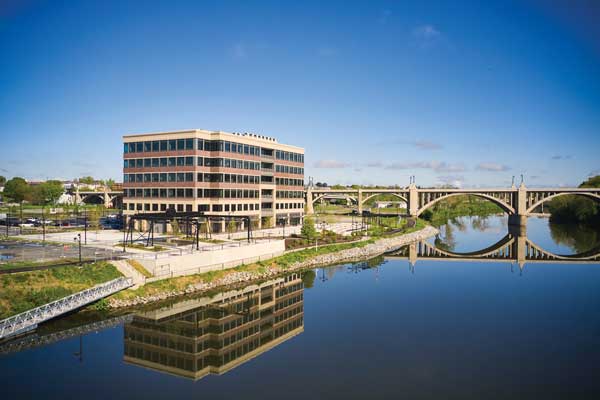
The Waterfront in Allentown aims to turn underused industrial land into a modern mixed-use district. J Taylor Design
Pat Lynch, executive managing director, CBRE Data Center Solutions, made the same point from the data center side. “Labor and talent are key components that play a major role in the selection decision,” he said. “Mechanics, electricians, technicians, laborers, construction workers [and] linemen/linewomen are all critical not only for the construction but also for the ongoing operation of any data center.”
He added that housing, hospitality, schools and airport access all help support major projects by making both construction and long-term operations more feasible.
Affordability helps hold that workforce in place. Adler said housing in the Midwest has remained relatively affordable compared with many other parts of the country. Multifamily rents have grown, but not to the extent seen in the Sun Belt. “That means the region maintains a cost-of-living advantage,” he said. “Housing markets are more balanced, less volatile and generally more predictable.”
Drawing Interest From Data Centers
Data centers have become one of the clearest signs that the Midwest is moving into a new industrial era.
“This has been a bright spot for the Midwest economy,” Barranco said. “These sites are all about power availability and infrastructure.”
Interest from hyperscalers is significant and concrete, as evidenced by Google’s forthcoming 480-acre data center site in Pine Island, Minnesota. The site has several key elements in place, including a clear and scalable plan for abundant clean energy, shovel-ready infrastructure, and private infrastructure capital investments that protect local ratepayers from exposure to project-related costs.
Lynch said the Midwest is becoming an attractive option for data centers for multiple reasons, including land costs, favorable development conditions, fiber connectivity, existing transmission lines for power, existing power generation plants and labor availability. “Clients and developers are looking for power wherever they can find it,” he said. “In many cases, the best options available recently have been in the Midwest.”
Industrial Decline and Hard-won Recovery
Other parts of the Rust Belt outside of the Midwest share in the redevelopment pressures seen across legacy manufacturing markets. Pennsylvania’s Lehigh Valley offers a clear example of the reinvention that is reshaping the old industrial heartland.
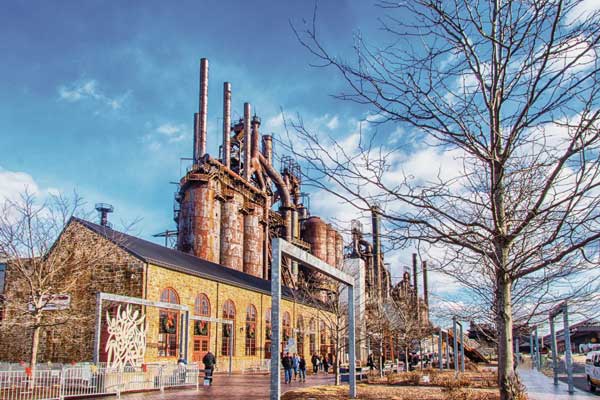
The adaptive reuse of a former Bethlehem Steel site turned into an economic catalyst for Bethlehem, Pennsylvania, and the wider Lehigh Valley. Craig Roberts
“Lehigh Valley is a mature market with a balanced and diversified economy,” said Kristin Cahayla-Hoffman, vice president of business development and attraction for Lehigh Valley Economic Development Corp. “Manufacturing has reemerged as a leading driver. There is an emphasis on placemaking — building safe and fun communities that provide opportunities for everyone. Our cities — Allentown, Bethlehem and Easton — have been revitalized with new housing, office space and entertainment venues. The population is growing, and the region is one of the leaders in the state in drawing young adults.”
Unlike 50 or 60 years ago, when one dominant employer could shape the region’s fate, Lehigh Valley now has a diversified economic base that includes life sciences, food and beverage, advanced manufacturing, professional and engineering services, and technology. Recently, Eli Lilly and Company announced plans to invest more than $3.5 billion in a new manufacturing facility in Lehigh Valley that will produce next-generation weight-loss therapies. For every dollar that Lilly invests, it estimates up to $4 in additional local economic activity, according to the company.
Lehigh Valley’s accessibility to Philadelphia, New York and the rest of the East Coast is a huge plus for the area. “Our location offers the advantage of lower land and lease costs and proximity to the ports, along with immediate access to other transportation infrastructure, including an international airport with a growing cargo hub and a network of highways putting companies within a day’s drive of one-third of the U.S. population,” Cahayla-Hoffman said.
Asked if there is a lesson in the economic reinvigoration of Lehigh Valley that could be applied to other areas of the Rust Belt, she said: “Lehigh Valley’s renaissance has been driven by our partnership-based, regional approach. Leaders in business, education, government and community organizations have worked together. We have prioritized talent development and site readiness and invested in quality-of-life improvements, from walkable downtowns to arts and trails, which help to attract and retain talent.”
Adaptive Reuse: One of the Area’s Strongest Development Tools
Adaptive reuse throughout Lehigh Valley has transformed former mills, industrial campuses, hotels and breweries into places that attract local residents, visitors and investment, all while preserving the kind of architectural character that new greenfield projects cannot easily replicate.
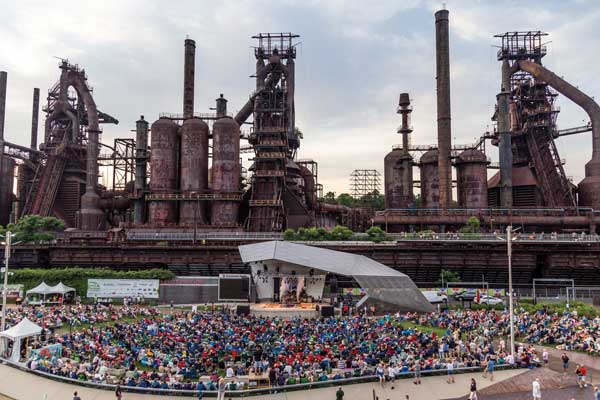
SteelStacks hosts large-scale concerts, festivals and other programming throughout the year. Jeff Auger
No project better illustrates the reinvention of Lehigh Valley than SteelStacks, developed through a public-private partnership led by the Bethlehem Redevelopment Authority. Approximately 10 acres of the 1,800-acre former Bethlehem Steel site was transformed into the nationally recognized arts, entertainment and community campus that is a hub of economic activity in downtown Bethlehem. SteelStacks hosts large-scale concerts, festivals, film programming, exhibitions, corporate events and community activations throughout the year, drawing more than 2 million visitors annually, according to Kassie Hilgert, president and CEO of ArtsQuest, which operates the site.
Hilgert explained that preserving the iconic blast furnaces and other core industrial structures on the repurposed site was not merely sentimental. Rather, it “maintained the authenticity and sense of place that differentiates SteelStacks from traditional redevelopment projects,” she said. “[Instead of] clearing the site, adaptive reuse allowed ArtsQuest and its partners to leverage the architectural scale, infrastructure and cultural heritage to create a destination with strong community identity [that is also a] tourism draw.”
Meanwhile, Easton’s R.H. Simon Silk Mill is one of Lehigh Valley’s most substantial adaptive reuse projects. The 300,000-square-foot, 15-building complex was converted over several years into 170 apartments and more than 30 mixed-use commercial businesses, turning a long-vacant silk mill into one of Easton’s most distinctive live-work destinations.
In Allentown, the former Neuweiler Brewery is being repositioned as Neuweiler Lofts, a mixed-use multifamily project on a site that sat vacant for decades. The redevelopment includes 282 apartment units and roughly 40,000 square feet of commercial space.
Cityplace is another example of adaptive reuse supporting Allentown’s downtown revival. City Center Group converted a former Holiday Inn into a 120-unit residential community, adding attainably priced apartments to downtown.
The Waterfront: Industrial Land Reengineered
If SteelStacks shows what happens when industrial heritage becomes a cultural anchor, The Waterfront in Allentown demonstrates what happens when underused industrial land is reengineered into a modern mixed-use district.
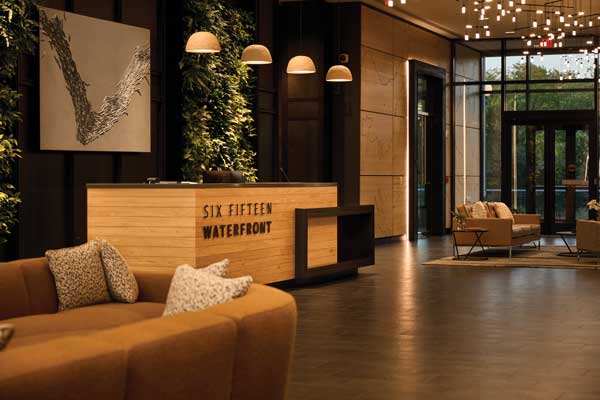
The lobby at Six Fifteen Waterfront, a six-story Class A office building within the larger Waterfront in Allentown development. J Taylor Design
“When we look at The Waterfront, it’s not just another development to us. Our family has lived here for generations. We went to school here. We built our lives here. This project is about reinvesting in the same community that gave us everything,” said Zachary J. Jaindl, chief operating officer of Jaindl Enterprises, which developed the project.
The 29-acre site was once home to Lehigh Structural Steel, a major fabrication plant along the Lehigh River. When foreign steel gained traction in the 1990s, the site went dark. There were a dozen dilapidated buildings. Nothing active. “A huge piece of land was just sitting there,” Jaindl said.
He had studied the property years earlier and concluded that redevelopment would not work without government help. “When the state introduced the Neighborhood Improvement Zone in 2012, that changed the equation. The numbers finally worked,” Jaindl said.
What followed were years of difficult site work. The company demolished the 12 industrial buildings, raised the entire site above the 500-year floodplain, installed 8 miles of underground conduit for fiber and electric infrastructure, and completed full environmental remediation.
“To bring a 29-acre former steel plant to residential environmental standards, that’s not simple work. It took years of testing and a significant investment. But if you’re going to do it, you do it right. … We saw that Lehigh Valley was short roughly 9,000 housing units. Rents had increased nearly 25%, and vacancy was well below the national average. Originally, the project was predominantly office. Now it’s predominantly multifamily, with office, makerspace and recreational opportunities integrated throughout.”
For Jaindl, The Waterfront’s larger lesson is about public-private partnership and long-term civic value. “Without the public side, it doesn’t work. Without the private side, it doesn’t work. It has to be both.”
He also measures success in fiscal terms. Jaindl said that when he acquired the site, it generated about $100,000 a year in real estate taxes; at full buildout, the project is expected to generate roughly $4.5 million in taxes annually.
Outlook: Capital, Hot Property Types and the Next Decade
Back in the Midwest, the story is not just about projects. It is about whether investors see these markets as strategic. Barranco said some Midwest markets still struggle to attract institutional capital because of liquidity concerns tied to lower transaction volume. “That said, we are observing solid operating performance in our Midwest real estate assets, so investors participating in the markets are seeing outsized returns and lower boom-and-bust scenarios,” he remarked.
According to Copella, “Institutional capital is moving into the Midwest for increased stability and higher yields compared to gateway cities and major markets. For multifamily, the Midwest offers a much higher level of stability versus the Southeast, which has been challenged by oversupply, hurricanes and dramatic increases in property insurance.” He added that “areas like Columbus and Indianapolis have growing populations and constrained housing pipelines, which promise both stability and future rental growth.”
In terms of product types, CBRE sees data centers, industrial and manufacturing projects as the fastest-growing and most successful sectors in the Midwest. From 2024 to 2025, the firm recorded a 41% increase in industrial leasing activity across the region, with more than 45 million square feet of new industrial product under construction.
Over the next five to 10 years, the region’s growth is likely to be concentrated in higher-value industrial uses, according to Adler. “We expect new industrial supply nationally to rebound over the next few years, and a greater proportion of that supply is likely to move toward the Midwest,” he said. “But the growth there is likely to be more about advanced manufacturing and digital infrastructure rather than traditional warehouse logistics.”
Copella is optimistic about what he sees taking shape. “I believe that the Midwest is entering a new era of growth — one that will create more housing, more job opportunities and, overall, more prosperity. This success will come with challenges, but its overall friendly business climate will allow it to shake that ‘rust’ off its shoulders.”
Ron Derven is a contributing editor to Development magazine.