
Firms positioned to lead the next cycle are treating AI adoption as a coordinated initiative across three pillars.
The conversation has become a fixture in conference rooms across the commercial real estate industry. Someone raises the question of artificial intelligence. Heads nod. A pilot is proposed, existing tools are rolled out or a tool is purchased, and a small team is assigned. Six months later, the tool sits underused, the team has moved on, and the next conference room conversation starts the cycle over again.
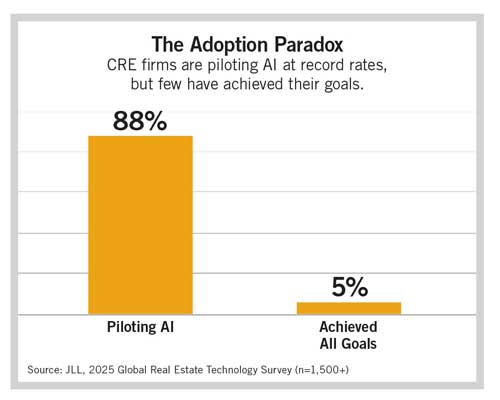
The pattern is remarkably common. According to JLL’s 2025 Global Real Estate Technology Survey, 88% of investors, owners and landlords have begun piloting AI, with most firms pursuing an average of five use cases simultaneously. A separate Dealpath survey of institutional investors in 2025 found that 96% plan to increase their AI spending in the next year.
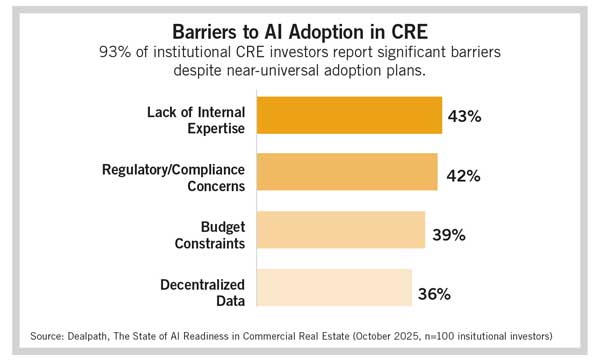
The enthusiasm is real. So is the gap between ambition and results. Only 5% of firms in the JLL survey reported achieving all their AI objectives. While 90% of firms in the Dealpath survey had established or were building AI-focused teams, 93% simultaneously reported significant barriers to adoption. The top obstacle, cited by 43% of respondents, was not budget or regulatory risk. It was a lack of internal expertise.
That disconnect between investment and preparedness defines the current moment. Meaningful AI adoption requires a coordinated approach across three pillars: standardized processes, practical application at the point of work, and an AI-literate workforce. Firms that invest in all three are positioned to capture what Morgan Stanley Research estimates could be $34 billion in efficiency gains for the real estate industry by 2030. Firms that address only one or two are building on sand.
Pillar One: Standardizing Before Automating
The most predictable failure with AI implementation has nothing to do with the technology. Gartner predicts that through 2026, organizations will abandon 60% of AI projects that lack AI-ready data. An S&P Global survey found that 42% of companies walked away from most of their AI initiatives in 2025, more than double the 17% that did so in 2024. RAND Corporation research in 2024 put the overall AI project failure rate at 80%, twice the rate of traditional technology projects.
The common thread isn’t that AI does not work. It is that organizations deploy AI on top of workflows, data structures and processes that were never designed to support it.
In commercial real estate, this problem is especially acute. For example, a firm decides to use AI for lease administration. The team selects a capable platform, invests in licensing and assigns a group to pilot it. Within weeks, the initiative stalls. Not because the AI cannot read leases, but because the firm’s documents are stored inconsistently across three systems, in varying formats, with no standardized naming conventions. The AI is not the bottleneck. The workflow is.
McKinsey & Company’s 2025 Global AI Survey confirms the pattern: Organizations reporting significant financial returns from AI are twice as likely to have redesigned their workflows before selecting technology.
The lesson is counterintuitive but critical. The most important work in AI adoption involves no AI at all. It starts with mapping how work actually gets done today, identifying bottlenecks, standardizing inputs and outputs, and establishing clear ownership. Only then can a firm evaluate where AI meaningfully improves a process versus where it accelerates existing dysfunction.
This work is not glamorous, and it is routinely skipped by firms eager to demonstrate AI progress. But it is the single most expensive step to skip.
Pillar Two: Deploying AI at the Point of Work
The process discipline described above is not an end in itself; it is what makes precise AI deployment possible. When workflows are mapped and data is organized, AI tools can be introduced with a specific role in the process rather than a vague mandate to “make things faster.”
The productivity gains at that point are well documented. A landmark Harvard Business School study conducted with Boston Consulting Group and published in 2023 found that consultants using AI completed 12% more tasks, finished them 25% faster and produced work rated 40% higher in quality compared with a control group. The study also found that lower-performing consultants saw the largest gains — a 43% improvement — suggesting AI has the potential to elevate performance across an entire organization, not just among top performers.
Those numbers translate directly into CRE workflows. A broker preparing a client update traditionally spends hours gathering comparable data, synthesizing market reports and drafting a narrative. With standardized inputs and AI tools, that deliverable can be produced in a fraction of the time, not by cutting corners but by automating the synthesis and first-draft stages while the broker focuses on analysis and client-specific judgment.
Document analysis illustrates the point at a more granular level. Dealpath’s survey found that 67% of CRE firms are already using AI for document analysis, making it the most common use case in the industry. In practice, this means an asset manager preparing for a quarterly portfolio review can upload a set of lease abstracts, ask the AI to identify every lease expiring within 18 months that contains an unexercised renewal option, and receive a prioritized summary in under five minutes. That same task across a 30-property portfolio typically consumes an entire business day without the use of AI. Development teams are applying similar capabilities to zoning documents, flagging regulatory constraints before committing resources to a site. Investors are using AI to extract financial data from lengthy offering memorandums, surfacing inconsistencies that would otherwise require hours of manual review.
The critical principle across all these applications is human-in-the-loop oversight. AI drafts; professionals verify. AI surfaces patterns; professionals make decisions. The Harvard study found that when consultants used AI for tasks beyond its capabilities, they were 19% less likely to arrive at correct conclusions. The technology is a force multiplier, not a substitute for professional judgment.
Pillar Three: Building an AI-literate Workforce
Tools and processes alone do not create lasting organizational change. Recall that the No. 1 barrier to AI adoption in the Dealpath survey was not technology, budget or regulation. It was a lack of internal expertise.
Broader data tells the same story. A 2025 AI readiness survey from DataSociety found that 65% of organizational leaders did not know when or where to apply AI, and 52% lacked a foundational understanding of how it works. The implication: The firms that will sustain AI adoption are those investing in their people, not just their platforms.
Effective AI training in CRE goes far beyond a one-hour vendor demo. The programs gaining traction share several characteristics. They are:
- Hands-on, requiring participants to work with AI tools rather than watch someone else do so.
- Role-specific, recognizing that a broker’s AI needs differ from those of an asset manager.
- Tied to actual workflows, teaching professionals to integrate AI into tasks that they already perform rather than presenting the technology in the abstract.
The Harvard study underscores why structured training matters. Consultants who received prompt engineering guidance before the experiment performed meaningfully better than those given unguided access to the tools. The researchers identified two successful patterns: “centaurs,” who clearly divided tasks between themselves and AI based on respective strengths, and “cyborgs,” who wove AI into every stage of their workflow. Both outperformed unstructured use, and both require deliberate skill-building to develop.
Beyond individual skill-building, organizations need governance structures that sustain AI adoption. This includes acceptable-use policies addressing confidentiality obligations, which are particularly important in CRE, where deal data and financial projections carry significant sensitivity. It includes internal champions who bridge the gap between technology capability and business need. And it includes executive sponsorship that signals AI literacy is a strategic priority.
Major CRE firms and industry associations are already moving in this direction, investing in structured AI education programs designed specifically for the commercial real estate context. The trend reflects a growing recognition that AI fluency is becoming a baseline professional competency.
The Competitive Imperative
Commercial real estate has never been an early adopter of technology, but the pace of AI development is compressing the timeline that firms have for responding. Findings from a 2025 Gartner Inc. survey showed that organizations with high AI maturity were more than twice as likely as low-maturity organizations to keep AI initiatives running beyond three years. The gap between leaders and laggards is widening, and it compounds over time.
The firms positioned to lead the next cycle are treating AI adoption as a coordinated initiative: standardized processes that give AI something solid to work with, practical deployment where it creates measurable value, and a workforce equipped to use these tools with confidence and judgment.
The next wave of capability is not theoretical. Agentic AI workflows that execute multistep processes, underwriting models that learn from a firm’s own deal history, and intelligent document systems that monitor an entire portfolio in real time are all approaching production readiness. The organizations that have built the three-pillar foundation will integrate these advances as natural extensions of work already underway. Those still cycling through disconnected pilots will face the same conference room conversation, starting from scratch.
The question for CRE executives is no longer whether to invest in AI. It is whether the investment has structure or only speed.
Jonathan Buckelew, CPA, Nadine Ezzie, Esq., and Topher Stephenson, MBA, are co-founders of the CRE AI Studio, an AI education and training platform built exclusively for commercial real estate professionals.
This article was written by the authors of NAIOP’s new course, AI in Commercial Real Estate, which provides a structured, CRE-specific approach to understanding and applying AI. Learn more at learn.naiop.org.
Five Questions Every CRE Executive Should Ask Before Their Next AI InitiativeBefore committing budget to AI tools or platforms, leadership teams should pressure-test their organizational readiness. These five questions, drawn from the three-pillar framework, can quickly reveal whether a firm is building on a strong foundation or racing toward an expensive pilot that stalls.
|