
New Research Foundation reports offer members practical guidance as capital markets continue to shift.
Commercial real estate lending and transactions increased in 2025 as declining interest rates provided a tailwind for the industry. However, while overall conditions for CRE have improved, sales and construction activity reveal significant variation across different property types. A slowing economy, above-target inflation and the recent conflict with Iran have also clouded the outlook for future interest rates.
To help industry professionals navigate this environment, the NAIOP Research Foundation has launched two recurring reports, both available only to NAIOP members, to track capital market trends.
The Debt Market Survey, Fourth Quarter 2025, authored by Omar Eltorai of Altus Group, provides quarterly insight into commercial real estate loan interest rates. The survey offers data on benchmark rates, spreads and all-in interest rates for office, industrial, retail, multifamily and construction loans, including both short- and long-term senior debt and mezzanine loans.
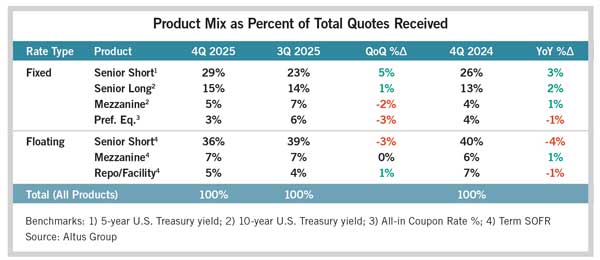
The results from the fourth quarter point to a debt market that continued to ease for borrowers. Benchmark rates declined in 2025 across all major indices, contributing to lower all-in financing costs for most product and collateral types compared with a year earlier.
The survey also highlights several changes in quoting and pricing activity across products and property types. Fixed-rate products continued to rise through 2025 and accounted for more than half of all quotes, while floating rate senior loans remained the most quoted structure but declined from earlier periods. Collateral patterns held mostly steady, with industrial as the most quoted sector and multifamily close behind, though respondents reported a higher share of quotes for non-trophy office loans than in earlier quarters.
Overall, the survey points to a debt market that is gradually recovering. Borrowers are benefiting from more favorable pricing, lenders are increasing participation in select areas, and product mix is shifting in ways that indicate rising confidence as market conditions continue to normalize.
The U.S. Capital Markets Report, H2 2025 describes a commercial real estate market entering 2026 in a transitional phase. Authored by NAIOP Research Foundation Senior Visiting Fellow Will McIntosh, Ph.D., and Executive Director Shawn Moura, Ph.D., the report draws on economic data, transaction activity, mortgage lending, valuations and development trends to provide insight into how capital is moving across property types. Liquidity has improved, valuations have stabilized, and both debt and equity capital have become more available, even as rate-driven volatility and broader uncertainty continue to influence investment decisions. The report observes that capital markets have largely adjusted to the disruptions caused by the rapid increase in interest rates that began in 2022, but activity remains closely tied to movements in long-term rates.
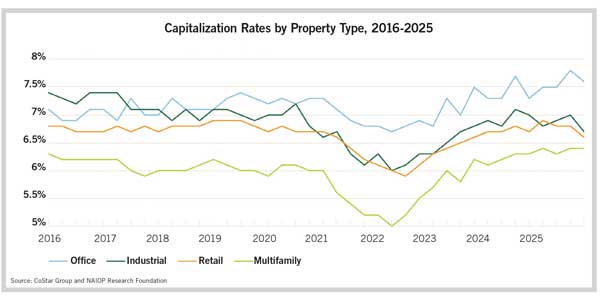
After surging during the low-rate environment of the pandemic, transactions slowed sharply as interest rates rose in 2022 and 2023. They began to recover in 2024, led first by multifamily transactions and then followed by other major property types. In 2025, pricing stabilized across most sectors, with cap rates leveling off in industrial, retail and multifamily, and office showing early signs of improvement. Development activity has followed a similar multiyear pattern, though the construction pipeline for multifamily and office projects continued to shrink in 2025.
Lending activity offered some of the clearest evidence of increased liquidity in recent quarters. Banks shifted from reducing their commercial (non-multifamily) mortgage holdings in late 2024 to becoming the largest net lenders to commercial real estate in 2025, marking a notable change in momentum. As a group, federal agencies, government-sponsored enterprises and mortgage-backed securities investors remained the largest buyers of multifamily mortgages.
Taken together, both reports offer timely insight into market conditions as the investment and lending environments continue to evolve. As 2026 progresses, these recurring reports will help NAIOP members calibrate strategy, evaluate risk and plan new projects.
Access the reports at naiop.org/research.
Max Shpilband is a research analyst for the NAIOP Research Foundation.