The founder and managing partner of KMT Partners, based in Atlanta, discusses building a new regional commercial real estate development and investment firm, finding value where others see only risk, and helping to build industry mentorship and leadership programs.

Gregory Boler Jr.
Development: You attended Florida A&M University with a time-consuming major in mechanical engineering. At the same time, you were a walk-on college football player at a Division 1 school, which is a high-risk, grueling effort with low odds of earning playing time or receiving a scholarship. How did those experiences help prepare you for a career in commercial real estate?
Gregory Boler Jr.: Mechanical engineering helped me develop strong problem-solving skills, and doing an engineering major and football at the same time forced me to develop strong time management skills. Both are necessary for a successful career in any industry, but especially in commercial real estate.
Development: How did it work out for you?
Boler: I tried out, made the team as a linebacker, earned a scholarship and traveled with the team for four years. I started my last two seasons there. That was the only way I was going to attend Florida A&M or any out-of-state school. I was the first in my family to go to college and finish a four-year degree. When I visited Florida A&M University for the first time, I fell in love with the school. The engineering school is a 50-50 partnership with Florida State, so I was sitting next to Florida State students.
Development: How did you become interested in the commercial real estate industry?
Boler: JLL recruited me at Florida A&M as part of their efforts to attract more diverse talent from technical backgrounds. JLL is the big reason I am in commercial real estate today. At JLL, I learned the bricks-and-sticks side of commercial real estate and development, primarily in the student housing, retail and industrial sectors. I fell in love with industrial — it looks simple from the outside, but it is really complex.
Development: What were your next steps in the business?
Boler: I joined what became Transwestern Development’s logistics platform as the East Coast partner’s first hire. He needed someone to execute on construction and permitting, but he also wanted a person with the aptitude to grow into a developer. That gave me the full developer process and perspective: land acquisition, legal, due diligence, sourcing equity and debt, understanding when capital is most at risk and how to mitigate that risk while maximizing value.
We expanded from Florida into Georgia, South Carolina, Virginia and Pennsylvania. Eventually, I became a partner — the youngest and first African American partner Transwestern Development had since it was founded. I then moved on to Bridge Logistics Properties, a logistics value-add and development capital deployment arm of Bridge Investment Group.
Development: What is the foundation of KMT Partners?
Boler: I founded KMT in September 2023. It is a minority-owned capital deployment vehicle and a third-party operator for investors and users who are focused on investment grade development and acquisition opportunities within the industrial and commercial spaces. The company focuses on speculative and build-to-suit development, value-add or core acquisition projects, as well as third-party asset and development management opportunities.
Development: What opportunities is the company pursuing?
Boler: There’s opportunity in tough sites where there is heavy entitlement risk, especially with infill locations on the East Coast. A developer can create value by having the expertise to solve entitlement challenges. However, diversification is essential, as no developer can sustain long-term success solely through development activities. KMT is not limited to industrial development. I have my first nonindustrial development in the pipeline, and I have closed on my first asset management service with a partner. Becoming more vertically integrated and diversifying revenue are important to withstanding the cycles.
Development: You helped establish the CRE internship program for the statewide Georgia chapter of the Commercial Real Estate Development Association. Why are mentorship and access important to you?
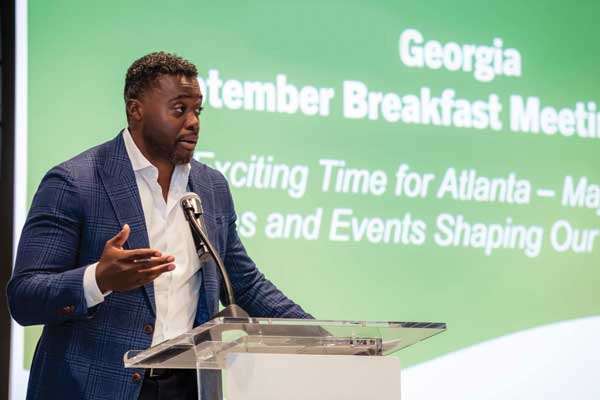
Speaking at the Georgia chapter of the Commercial Real Estate Development Association, where Boler helped establish a CRE internship program. KarenImages.com, courtesy of Gregory Boler Jr.
Boler: It comes back to why I am here. If it were not for JLL recognizing that equitable diversity has financial value for companies — because of the innovation it creates and the trajectory of where America’s demographics are going — I might not be in commercial real estate. I want to provide the same opportunities to others that somebody provided to me.
The biggest advantage is access; it is not just about exposure. CRE is a relationship business. At the end of the day, knowing someone, growing up or going to school with someone, or being a family member of someone is often how people get into this industry. I wanted to offer exposure for students who are close to becoming young professionals and who have a strong interest in the CRE industry but also provide short-term access by placing them with companies that understand the value. This was the program’s sixth summer of interns. We have interns from all different types of backgrounds. However, we focus on providing opportunities for minority groups that are historically and significantly underrepresented.
Development: KMT has remained lean, and you’re the sole employee. Why have you taken that approach?
Boler: Any company’s smartest strategic bet is to hire only when needed. I learned that until revenue projections can cover an employee for two years, hiring should wait. I brought that approach to KMT and expect to hire this year or next. During cyclical times or if there is another downturn, I want to ensure the company is sustainable and cover the team through market ups and downs.
Development: Does industrial real estate still have a long runway?
Boler: It is definitely challenging because of NIMBYism, utility and infrastructure constraints, and land constraints. But capital allocations are still very much focused on the industrial sector. From an e-commerce standpoint, the U.S. is still around 20% of overall retail sales, which is low compared with Europe and China. Also, there’s additional demand from domestic manufacturing and AI.

Gregory Boler Jr. and his family show their support for Florida A&M University, where Gregory majored in mechanical engineering and played football. Courtesy of Gregory Boler Jr.
I do believe there is a longer runway, but it is going to take more public-private partnerships to educate communities about why industrial real estate is sometimes located where it is. Industrial cannot be just anywhere. There are locations and corridors that were intrinsically made for industrial, and those are the places where we should be leaning in.
Development: As KMT begins to grow, how do you plan to build its culture?
Boler: It is all about relationships. It’s important to me to build the company with people I’ve worked with in different capacities, colleagues I trust, and individuals I’m confident can deal with challenging scenarios and come out successfully on the other end. They need to be open to direction, but also vocal if they see risk ahead. They need to be able to raise their hand and say, “Here is a risk,” and then collaborate on the best way to solve that problem.
Development: Looking ahead five to 10 years, where do you see KMT Partners?
Boler: Right now, I am focused on the East Coast because those are the markets I know. But my goal is to have partners in certain markets where I am bullish and that have great foundational value from an industrial standpoint. I look at Trammell Crow, Transwestern, Panattoni and Dermody. They showed us a great blueprint that can be duplicated if the focus stays entrepreneurial and creative and if you invest in good people. The goal is to be national — and then scratch the surface on global.
Development: How do you spend your time away from work?
Boler: I am married and have two boys, ages 8 and 12. They are very active and play football, basketball, track and golf. I am very involved and have coached both at different points. I am also deeply engaged locally with 100 Black Men of Atlanta, which is focused on mentorship and education empowerment for youth in the Atlanta metro area. I am active in my fraternity, Omega Psi Phi; serve on the board of an affordable housing developer focused on socially equitable housing; and sit on the 2026 Commercial Real Estate Development Association Executive Committee as vice chair of education. I’m also past president of the Georgia chapter. So outside of work, it is family, mentorship, community and service.
Ron Derven is a contributing editor to Development magazine.