Rethinking performance, systems and long-term value on the path toward Real Estate 6.0.
The real estate industry is undergoing a structural transformation. Digital technologies are reshaping how assets are designed, financed and operated, while forces such as urbanization, affordability constraints and climate risk are redefining what long-term performance means.
In this context, human-centricity is emerging as a strategic priority. It is increasingly associated with value creation, tenant satisfaction and asset resilience. Despite its growing importance, the concept remains inconsistently defined across the industry. In real estate, human-centricity is frequently framed in terms of design features, amenities or user experience. While these elements are essential, they do not fully capture what is required for buildings to perform consistently as conditions evolve.
The Data Fragmentation Problem
The real estate industry has made significant progress in digitization and the adoption of proptech. However, data fragmentation in real estate is widely recognized as one of the industry’s most persistent challenges, limiting decision-making, slowing transactions and constraining the use of artificial intelligence. Information is often trapped in disconnected systems and workflows, creating a fragmented view of assets.
This lack of continuity leads to inefficiencies, manual processes and a reduced ability to anticipate risks, respond to changing conditions and understand how people experience the built environment. In such conditions, human-centricity cannot fully emerge, as the system itself does not support it.
Over the past decade, efforts to address this problem have focused on integration. Application programming interfaces (APIs), common data environments (CDEs) and centralized platforms have improved connectivity between systems, allowing data to move more easily across tools and teams. These developments represent important progress. However, connectivity alone does not create coordination. It ensures that one system can send data to another, but it does not guarantee that the receiving system will trigger a workflow, update a risk profile or prompt a decision. Without coordination, silos persist in a new form: Data becomes accessible, but it is not translated into action or decision-making.
From Connectivity to Coordination
For systems to truly coordinate, four capabilities become essential:
- Governance, which defines how data is used through clear rules and responsibilities.
- Decision logic, which ensures that data is interpreted in context.
- Process execution, which translates data into action.
- Continuous learning, which allows systems to adapt over time.
This move from connectivity to coordination is part of a broader transition currently underway across industries. Industry 4.0 focused on connectivity, automation and data-driven processes. Industry 5.0 builds on this by placing human-centricity, sustainability and resilience at the center of performance.
Applied to real estate, this transition is giving rise to what can be described as Real Estate 5.0. Buildings are no longer treated as static assets but as continuous, data-driven systems. Performance is supposed to be shaped over time through interaction between people, technology and the built environment.
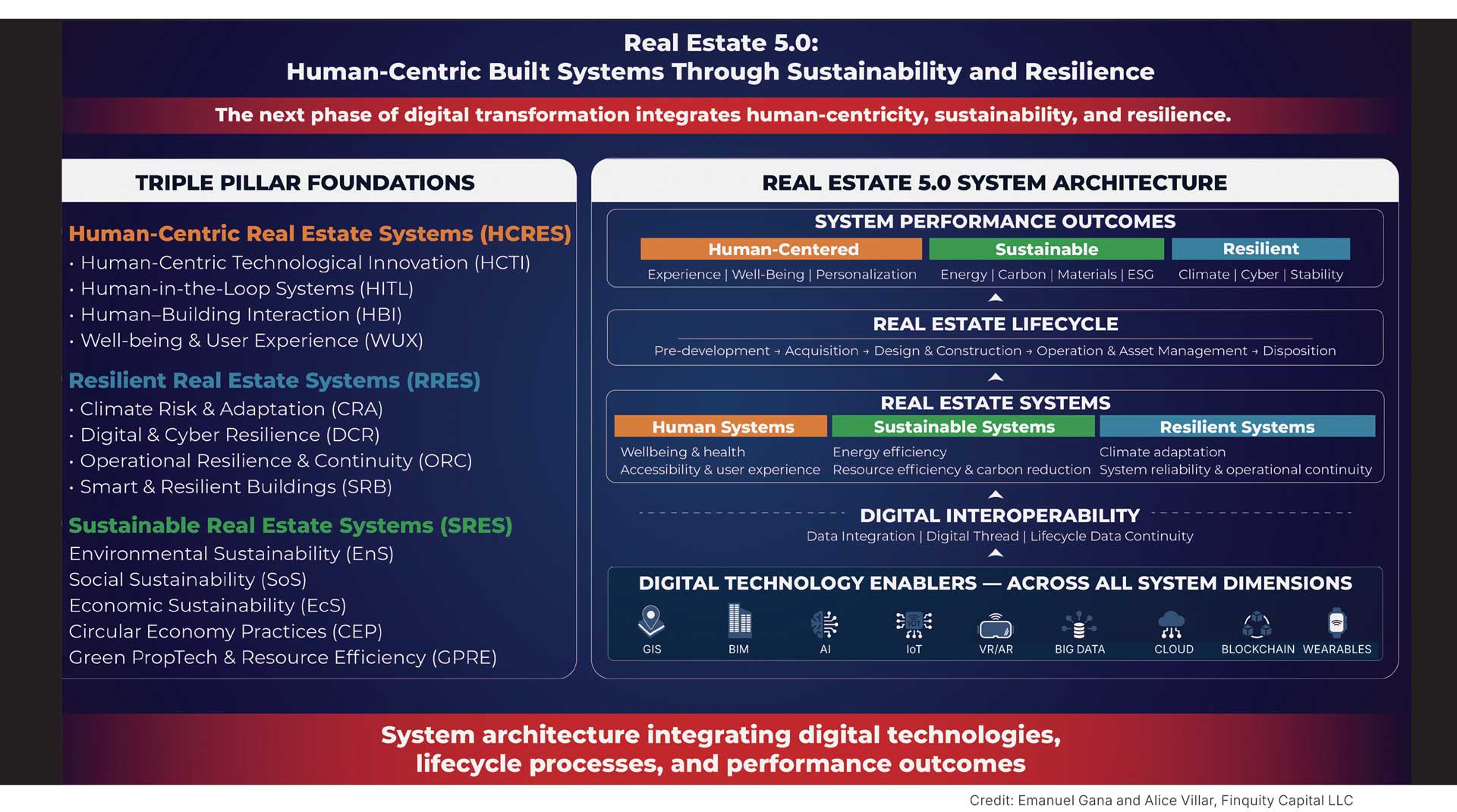
In this context, building on our previously published research, we propose a system architecture for human-centric real estate (see figure below) that organizes these elements into a coherent structure.
The architecture is organized as an integrated system:
- Digital technologies form the foundation, enabling data capture and processing.
- Interoperability is the critical condition that allows these systems to function as a unified whole.
- On this foundation, human, sustainable and resilient systems operate as interconnected performance dimensions.
- These systems extend across the life cycle, ensuring continuity.
- At the top, performance emerges as an outcome, defined by the ability to align human needs, environmental conditions and operational requirements over time.
This transformation redefines value creation. Buildings begin to operate as performance platforms, with outcomes continuously monitored and adjusted. Space becomes dynamic, evolving in response to user behavior. Operations generate intelligence for future decisions. In this sense, real estate becomes a learning system.
When Human-centricity Becomes a System Property
Within this evolution, the meaning of human-centricity itself changes. In earlier stages, it was associated with comfort, ensuring adequate lighting, temperature and safety. Later, it expanded to include experience, with a focus on wellness, amenities and tenant satisfaction. Now, a third stage is emerging in which human-centricity is defined at the system level.
At this stage, the question is whether the system can sustain performance over time, adapting to changing needs while maintaining environmental and operational stability. Human-centricity becomes inseparable from sustainability and resilience. A system cannot be truly human-centric if it compromises long-term environmental viability or fails to withstand shocks and disruptions.
Real estate operates as a system of systems. In this view, design, construction, operations and asset management are interconnected components of a larger architecture. Performance emerges from how these components interact rather than from any single feature or technology.
From Buildings to Systems
In a coordinated system, data is captured at each stage, shared across systems and used to inform decisions over time. The life cycle becomes a continuous decision system where performance is actively managed and improved. This creates the conditions for real estate to operate as a responsive and adaptive environment.
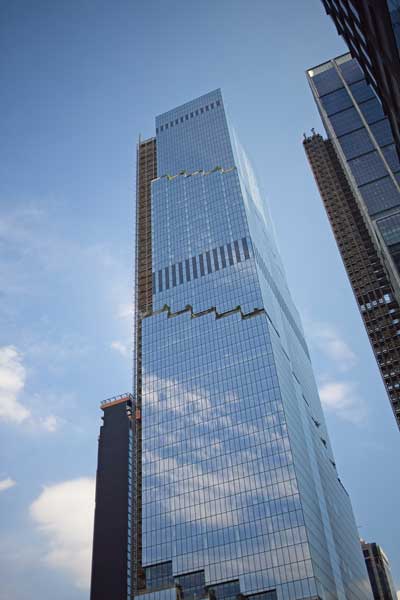
Building operations at The Spiral are coordinated through an integrated platform that connects environmental controls, energy management and irrigation systems. Warren Eisenberg via iStock Editorial/Getty Images Plus
The Edge, designed by PLP Architecture for Deloitte in Amsterdam, is the most widely cited example of this transformation. Often regarded as one of the world’s most advanced smart buildings, it demonstrates how human-centricity, sustainability and operational performance can be integrated within a single coordinated system. At its core, data collection is driven by human needs. The system continuously captures information about how people use space, ensuring that operational decisions reflect real patterns of occupancy, behavior and preferences.
A “digital ceiling” of over 28,000 sensors tracks occupancy, lighting, temperature and humidity in real time, allowing the building to adjust as conditions change. As users move through the space, the system aligns energy use and operational behavior accordingly. At the same time, a mobile interface allows users to personalize their environment, creating a continuous feedback loop between human intent and system response.
This integration allows the building to continuously respond to changing conditions, turning performance into an ongoing process. The building operates as a net-positive energy system and holds a BREEAM-NL rating of 98.36%, one of the highest ever recorded. It has reported no employee comfort complaints, while 72% of users indicate a sense of control over their environment. These outcomes demonstrate how sustainability, human-centricity and resilience emerge through continuous system-level coordination.
The Edge is not an isolated example. The same system-oriented approach is increasingly visible in North America. One example is The Spiral in New York, where building operations are coordinated through an integrated platform that connects environmental controls, energy management and irrigation systems. The platform manages water reuse, supports the building’s cascading gardens and continuously optimizes energy performance. Human-centricity is also embedded within the building’s design strategy. The Spiral, developed by Tishman Speyer, incorporates extensive outdoor terraces, customizable workspaces and collaborative environments intended to support occupant well-being and flexibility.
Despite their differences, both projects illustrate the same underlying principle: Sustainability, human-centricity and resilience emerge through coordination rather than through isolated technologies.
Scale-up Effect: Toward Real Estate 6.0
This shift toward integrated performance does not stop at the building level.
In Real Estate 5.0, assets operate as continuous, data-driven systems. This requires a shift toward more dynamic models, such as Building-as-a-Service (BaaS), where performance is continuously monitored and adjusted over time.
As this logic evolves, integration extends beyond individual assets. Buildings begin to connect with broader urban systems, including energy networks, mobility infrastructure and digital platforms. Performance is no longer defined solely within the asset but increasingly depends on how effectively it interacts with larger systems.
This gives rise to a scale-up effect: Coordination moves from the building to the district, and from the district to the city.
Within this emerging landscape, Real Estate 6.0 represents the next phase of development. Real Estate 5.0 introduced the Learning Building. Real Estate 6.0 takes the next step: the Interconnected Network. Buildings become nodes within larger, coordinated networks. Industry 6.0 has been projected to emerge between 2050 and 2070.
Performance, in this context, is defined not only by how buildings operate internally, but also by how effectively they interact with and contribute to broader systems over time. This marks a transition from isolated assets to coordinated, adaptive environments, laying the foundation for the next evolution of real estate.
Emanuel Gana is founder and managing partner of Finquity Capital LLC, where he leads investment strategy, acquisitions and asset execution. Alice Villar is head of research and strategy at Finquity Capital, where she leads the firm’s research initiatives on emerging technologies, digital transformation and innovation in real estate.
|
Have a technology use case that you’d like to share with CRE professionals? |