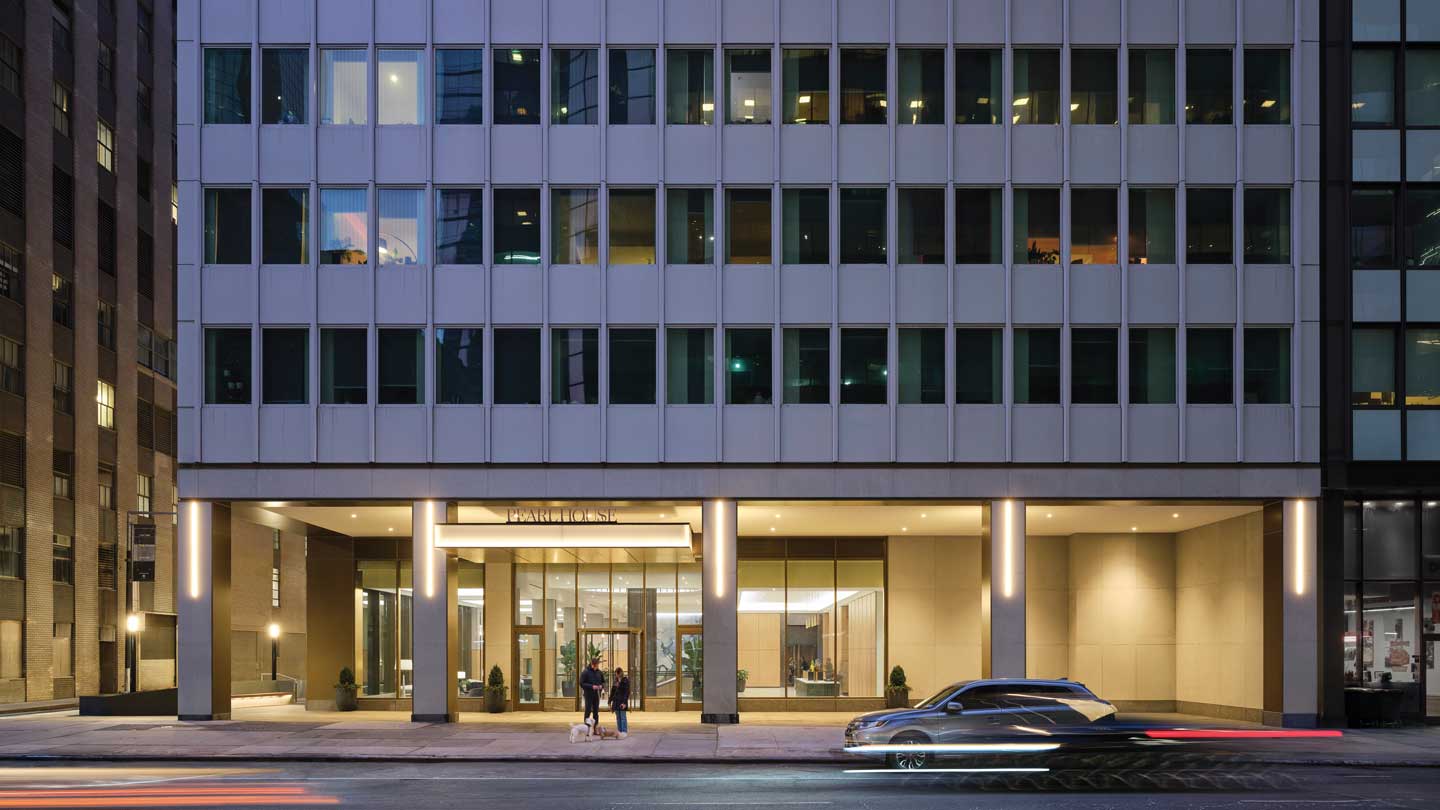
New zoning rules and tax incentives are helping to fuel a new wave of office-to-residential conversions in New York City.
As commercial real estate professionals are well aware, the COVID-19 pandemic substantially transformed how and where many people work. From 2019 to 2023, the number of Americans working remotely on a full-time or part-time basis more than doubled, and between 2016 and 2022, Canadians working mostly from home rose from 7% to 24%. While the trend has flattened out in the U.S. and began to reverse in Canada (17.4% of Canadian workers were remote as of May 2025), the pandemic’s impact on the commercial real estate market in many major North American cities is ongoing.
New York City offers a prime example. A March 2025 survey by the Partnership for New York City found that 57% of Manhattan office workers came in on an average workday — approximately 76% of pre-pandemic attendance. Through the first quarter of 2026, the office vacancy rate in Manhattan stood at almost 20%. According to one estimate, New York City’s vacant office space equates to more than $7.6 billion in lost rent per year, more than triple the U.S. city with the next highest value of unused office space, Los Angeles.
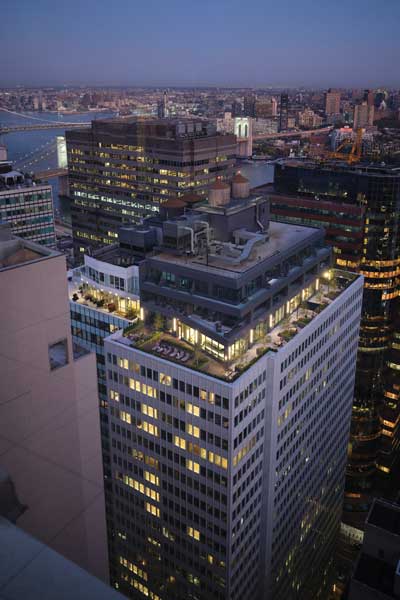
Among the new residential-friendly amenities at Pearl House are a terrace that wraps around the 28th floor of the building, where coworking and event space are located. Robert Deichtler, courtesy of Gensler
At the same time, Manhattan’s residential vacancy rate fell to 1.55% in April, and its median rent rose to an all-time high of $5,099. City and state lawmakers have made several moves in recent years to boost New York City’s housing production, but demand still outpaces supply.
This need for more housing presents a potential opportunity for commercial real estate developers and investors struggling to fill their empty offices: Turn them into apartments.
The market appears to be responding. Office-to-residential conversions are not a new concept in the city, but spurred by new, more flexible zoning rules, these projects are reaching new heights. Thirty-one office-to-residential conversions are expected in 2026, 13 more than the year prior and more than three times the conversions completed in 2024.
Where Office Conversions Are Taking Place
Most office conversions are happening in Midtown and the Financial District, Manhattan’s two office hubs.
In Midtown East, SL Green Realty Corp. has filed plans to convert a 35-story tower into 680 residential units. Not far away, Pfizer’s former headquarters is being turned into 1,600 rental apartments by Metro Loft Development and David Werner Real Estate Investments. (The Pfizer conversion, one of the largest ever planned in the United States, was put on hold July 7 after two support beams buckled, causing several of the upper floors to sag; workers and residents of several nearby buildings were evacuated.)
In FiDi, GFP Real Estate has opened two buildings to residential tenants in the past two years, SoMa on 25 Water St. and Wrey on 222 Broadway, yielding more than 2,000 new units.
Vanbarton Group, a real estate investment firm with both residential and commercial buildings in its portfolio, is behind several recent or ongoing office-to-residential conversions. One of them is Pearl House on 160 Water St. Built in 1972, the 24-story, 533,000-square-foot office building was converted in 2023 to a 30-floor residential building with 588 apartment units. The units are a mix of studios, one-bedrooms and two-bedrooms.
A terrace on the 28th floor wraps around the building, encircling a coworking and event space. In the cellar, tenants have access to a gym, whirlpool spas and a two-lane bowling alley, among other amenities.
A Good Candidate for Residential Conversion
When Vanbarton acquired Pearl House in 2014, the plan was to keep it an office building, but when the pandemic hit, the firm reevaluated, said Malek Hajar, senior project manager of development at Vanbarton.
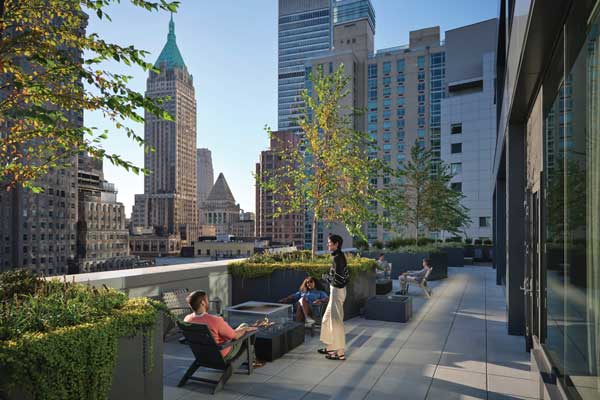
Pearl House is a 30-floor residential building with 588 apartment units. Robert Deichtler, courtesy of Gensler
“What made it a great candidate [for conversion] is the light and air on three sides of the building. And it’s a rectangle all the way up, so it allowed for nice layouts and good floor plates,” he said.
Air and light are key components in evaluating whether an office building is suitable to convert into residential units. New York City has strict requirements for windows in habitable spaces; no similar rules exist for office buildings, and many — especially those built in the second half of the 20th century — have floor plates too deep to allow light into the center.
Pearl House shares its block with only one other building (180 Water St., another of Vanbarton’s office-to-residential conversions), which means it receives light from all but one side. Still, the floor plate was too deep for the center to be usable for apartments. But because the core of the building was offset, Vanbarton Group and its design partner Gensler were able to create blind shafts in the center of the building, removing the floor area there and adding it to the middle (where there had previously been two floors of mechanical space) and top of the building. Because the floor area ratio didn’t change, zoning rules allowed for the floor space to be reallocated.
Encountering Challenges
Turning offices into apartments is often more complex than building from the ground up.
“You’re dealing with existing conditions; every single day you’re thrown a little curveball,” said Peter Wang, design director and office developers leader at Gensler. Pearl House was the architecture firm’s first office-to-residential conversion.
At Pearl House, raising the building’s height required Gensler and Vanbarton to reinforce the structure for additional lateral loads. The solution involved adding lateral braces to every floor from the top of the building down to the foundation. Designing the apartments around this became a challenge.
“No one wants to walk into an apartment and bang their head on a diagonal brace, so we had to carefully plan the units on every single floor so that the demising walls would basically bury the lateral braces,” Wang said.
The development team also had to replace the windows, both to be code compliant (habitable rooms must have operable windows) and to improve the building’s energy efficiency. According to Gensler, 20,000 metric tons of carbon dioxide was saved thanks to the conversion.
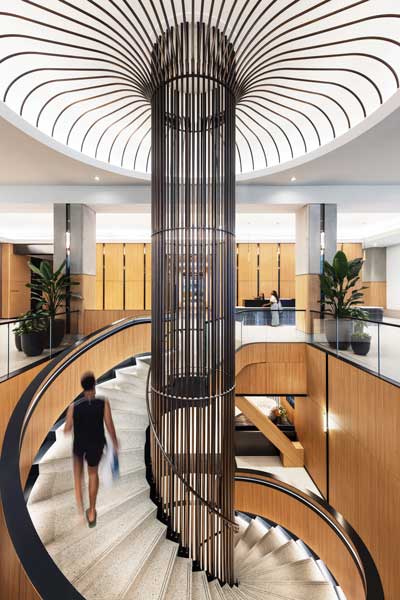
Pearl House represented architecture firm Gensler’s first office-to-residential conversion. Scott Frances, courtesy of Gensler
Still, from a design standpoint, light remains the primary challenge for office-to-residential conversions. Wang has worked on projects where a light well was created through the center of the building, allowing for additional units facing the courtyard. On another conversion, Gensler is carving a notch into the front of the building.
“The whole issue of deep floor plates and light is kind of central to converting these buildings, and there are a number of strategies,” said Peter Bafitis, managing principal at RKTB Architects. He added that the deep sections are “a good place for building amenities and the type of uses that are not residential but support the residential use.” In mixed-use buildings, the parts that don’t receive natural light could be reserved for commercial use, he suggested.
Zoning and Vacancy
Picking the right office building to convert comes down to more than just design choices. Brian Steinwurtzel, CEO and principal of GFP Development, a GFP Real Estate-affiliated development platform, highlighted two factors: No zoning changes must be required, and there must be a path to vacancy, meaning there are no office tenants, the tenants have natural expirations in their leases, or they are willing to move.
When GFP Real Estate converted Wrey, which opened to residential tenants this past spring, it still had several commercial tenants. Fashion giant Zara and banks Chase and Santander operated out of the retail fronts, while companies like American Express and WeWork leased offices in the upper half of the building.
“We had to convert the bottom half of the building while the retail and the top half were occupied,” Steinwurtzel said. By the end of 2025, all office tenants had vacated, and the top half is now under conversion.
Hajar said Vanbarton also phases its certificates of occupancy on office-to-residential conversions to allow for part of the building to open before construction is complete.
John Vavas, real estate finance lawyer with Polsinelli, has seen examples of developers and owners of commercial properties including a clause allowing them to unilaterally terminate the leases in case they want to convert the property’s use. However, many opt to simply buy tenants out of their leases ahead of a conversion.
“Sometimes folks try to take the path of least resistance, and sometimes that involves just paying. But I definitely think having a contractual right to do something bolsters your ability to effectuate the conversion,” Vavas said. If there are tenants whose leases aren’t expiring or terminable, a buyout should be included in the budget, he added.
The Economics of Conversion
Ideally, Steinwurtzel said, the developer can acquire the office building at a discount to help the conversion project make sense financially. “There’s a significant amount of money that needs to be invested into an office building to turn it into a residential building,” Steinwurtzel said. It’s a “very risky business,” he added, which means lenders generally charge higher rates and equity investors require higher yields. “If you cannot provide that level of return on their investment … then the project won’t happen,” he said.
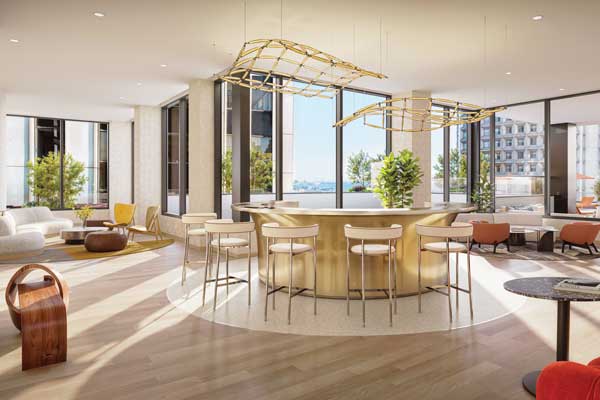
A rendering of SoMa, an office-to-residential conversion from GFP Real Estate in Manhattan’s Financial District. Streetsense, courtesy of GFP Development
Vanbarton secured a $272.5 million loan to finance its conversion of Pearl House. Meanwhile, GFP Real Estate received a $535.8 million loan to acquire and convert 25 Water St. into SoMa and $288 million in construction financing to convert Wrey on 222 Broadway after acquiring the property for $147 million.
The appetite for lending capital to office-to-residential conversions is currently robust, according to Vavas. “If the deal makes sense on paper from an economics perspective, it’s a good asset class,” he said.
Changes to New York City’s zoning laws in recent years have made these conversions more lucrative investments. Most notably, “City of Yes” zoning provisions, passed in 2024, made office properties built as late as 1990 eligible for conversion (previously the cutoff was 1961) while also relaxing restrictions for where conversions can happen and allowing for conversions into more kinds of housing. Developers are now also able to make their buildings denser, allowing more apartment units within the same property.
During his administration, Mayor Eric Adams established an Office Conversion Accelerator program, designed to speed up the conversion process.
In addition, New York state’s 467-m tax incentive has been a boon for commercial real estate developers, providing real property tax exemptions for conversions of nonresidential properties if at least 25% of units are designated as affordable based on the area median income.
Hajar praised the 467-m program and cited City of Yes as an important step toward mitigating the city’s housing crisis. “We think that the more supply, the better the pricing can be,” he said.
Impact on the City’s Housing Crisis
The cheapest studio apartment available at Pearl House in June rented at $4,150 per month; in a city where the median household income is $79,713, the luxurious living of Pearl House and similar projects is solidly out of reach for millions of New Yorkers.
For those who can afford it, however, the location and amenities likely justify the price. In theory, they are also leaving their less expensive apartments available for lower-income residents to occupy.
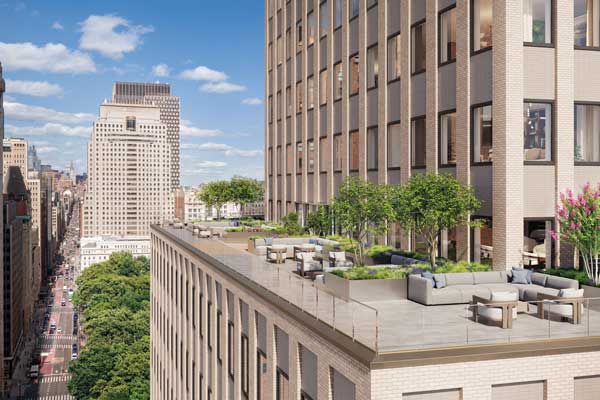
A rendering of Wrey on 222 Broadway. Hayes Davidson, courtesy of GFP Development
The Brain Gain, a 2025 report from the Downtown Alliance, indicates that at least the first part of that theory is holding true. Since 2012, the number of college graduates living within a 30-minute commute of Lower Manhattan has increased by 182,000, while the creative and professional workforce — which includes many who can afford higher rents — saw 22% growth within the 30-minute commute area.
“New York City has a substantial shortage of residential housing, and conversions are a great opportunity to start to eat into the supply that we need to create,” Steinwurtzel said.
A 2015 study from the NYU Furman Center further found that in high-rent neighborhoods — like FiDi and Midtown — tax incentive programs that mandate affordable housing can “encourage the development of more affordable housing without any additional subsidy.”
During her time as professor of practice at the New Jersey Institute of Technology, Carrie Bobo conducted a project investigating how office-to-residential conversions can create more equitably mixed housing. She noted the 467-m program mandates not just a certain number of affordable units but also that they are not isolated to a specific floor or area.
“Conversions provide a real opportunity to build really high-quality low-income and supportive housing mixed into higher-income buildings,” she said.
Converting Pearl House from offices into apartments took about 30 months, according to Hajar, who added that a ground-up project would likely have taken at least double that time. Thus, office-to-residential conversions offer a relatively quick way to get new units on the market.
Adaptive Reuse as a Greener Solution
Bobo suggested office-to-residential conversions also offer an opportunity to lower the carbon footprint of the built environment. The buildings and construction sector accounts for over a third of global emissions, making adaptive reuse a much more environmentally friendly option than demolition.
“All the carbon that’s stored in the frames and structures of these buildings is a big deal because they’re [made] of concrete and steel,” Bobo said. “As long as they sit where they are, their carbon cost is kind of preserved, but if you tear them down, that carbon cost is lost.”
Old office buildings, whether occupied or vacant, also tend to be electricity gobblers. Adding insulation, upgrading to today’s energy-efficient windows, and modernizing the building’s mechanical, electrical and plumbing equipment can significantly decrease energy use.
Bafitis said office-to-residential conversions “plug into something even bigger in terms of a philosophical current in architectural thought and urbanism, [which is] that we really shouldn’t be demolishing any buildings. We should try to work with buildings as they are. The demolition of a building is a supreme act, and it’s fundamentally wasteful and unsustainable.”
Eric Newstrom is a freelance journalist based in New York.
Units underway at the start of 2026 as a result of office/nonresidential-to-residential conversions:New York: 16,358 Note: Data from Canadian cities does not specify the original use of a unit, only whether it was residential or nonresidential. In Canada, hotels are the second most common type of property to be converted into residential. Sources: RentCafe, CMHC (Canada Mortgage and Housing Corp.) |