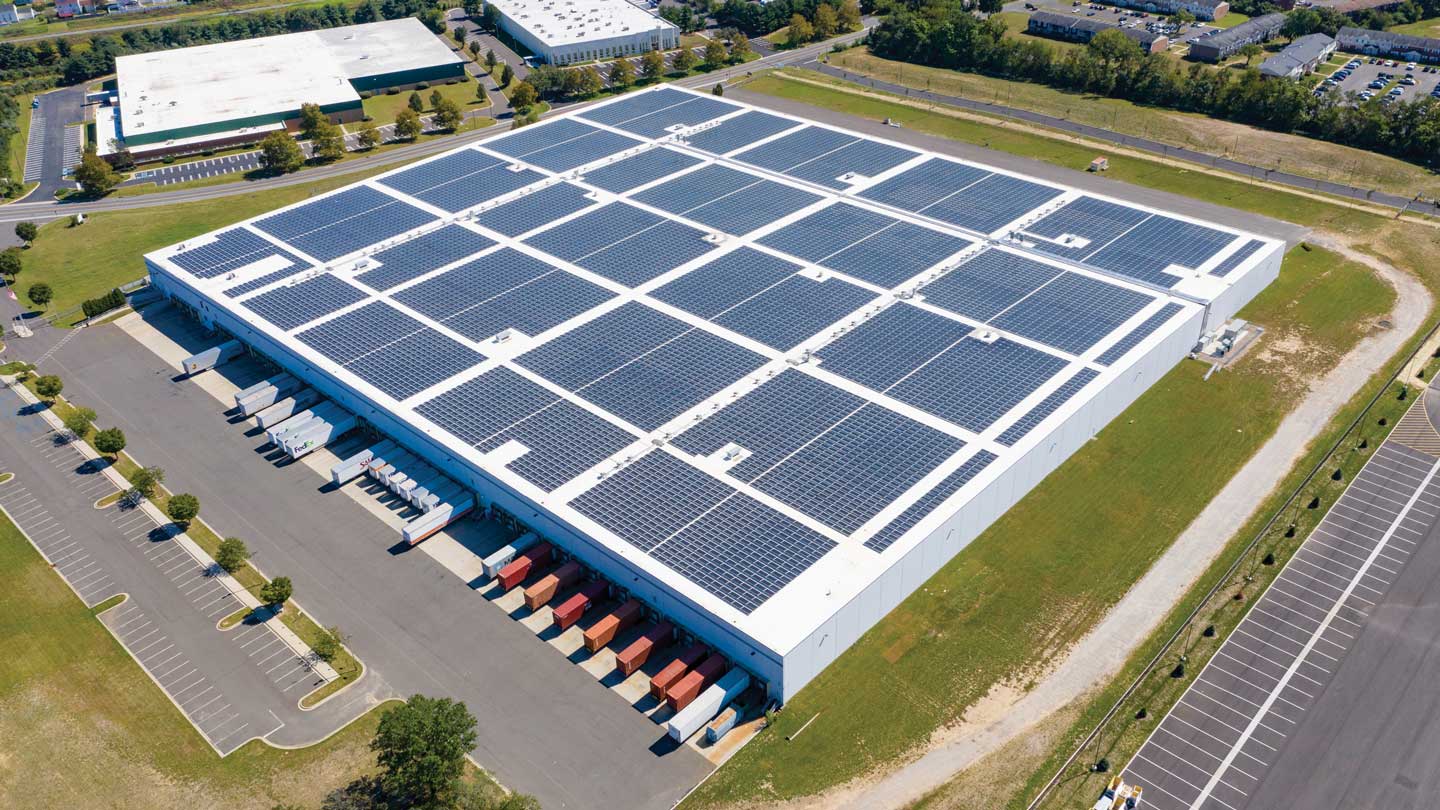
Rising electricity costs, an emphasis on risk management and a maturing industry are pushing the transition of solar from sustainability checkbox to profit center.
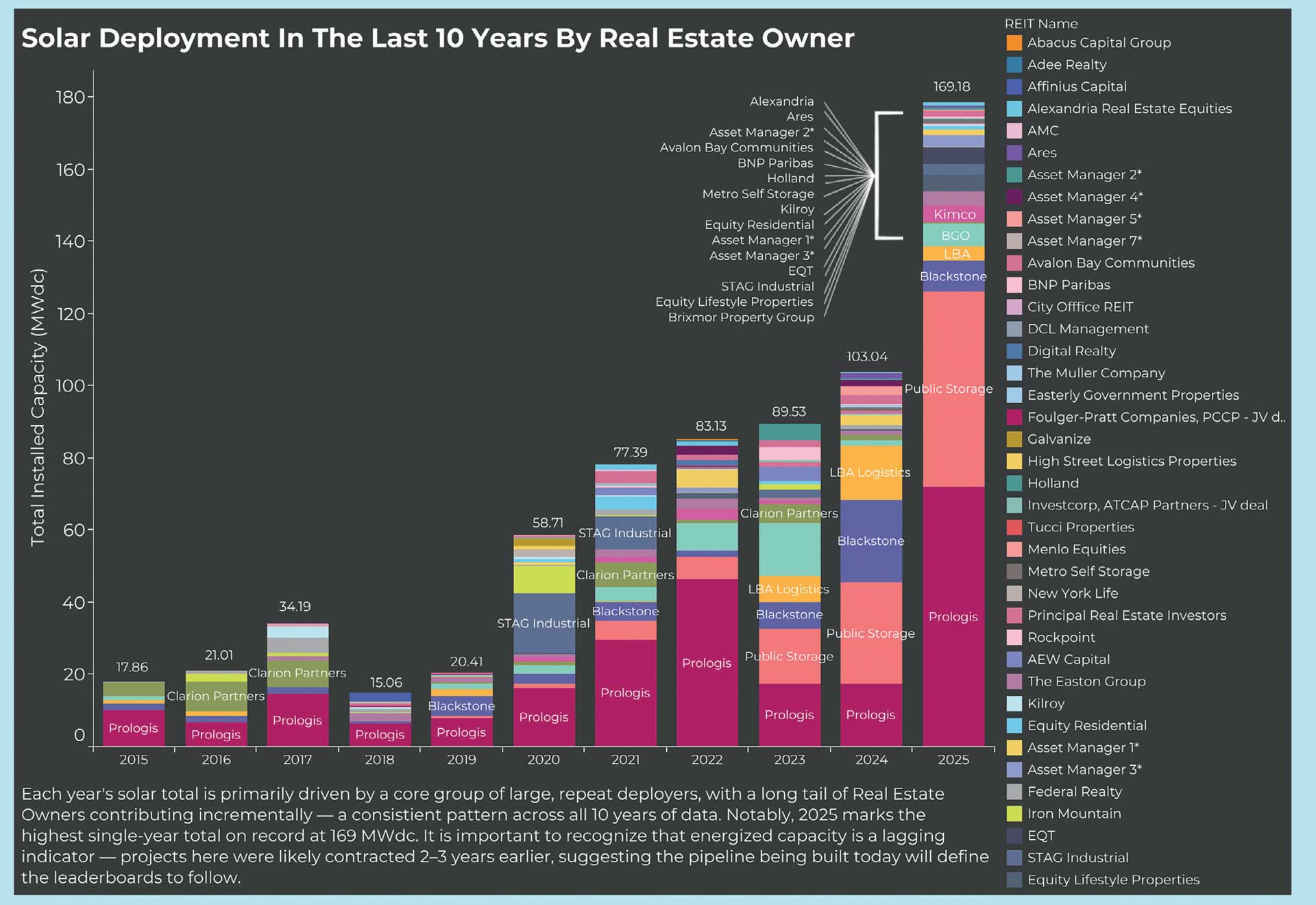
Solar on commercial real estate is no longer a sustainability or ESG checkbox — it has become a strategic value-add opportunity for real estate portfolios. Black Bear Energy’s 2025 Solar Leaderboards (Leaderboards) underscore this shift, revealing that the industry has deployed 1.086 gigawatts direct current (GWdc) of installed capacity across 2,157 projects and 65 real estate owners/managers in the United States. This makes 2025 the single-highest deployment year on record, with 169 megawatts installed — a significant increase from the prior five-year average of 82 MW.
While this growth is impressive, a 2023 Morgan Stanley report quantified the total addressable market for solar on REITs at 328 GW, highlighting vast untapped potential and showing that the industry is only just getting started.
The Economics: Markets and Geography Matter
A convergence of high electricity prices and solar-friendly policies has created favorable market conditions that make on-site and rooftop commercial and industrial solar projects financially compelling, but markets and geography matter.
Three variables largely impact project economics:
- Electricity costs
- Solar irradiance (kWh/kW annually)
- Solar-friendly policies
Solar-friendly policies can take many forms, including net metering, additional kWh revenue sources (such as solar renewable energy credits or similar), up-front rebates, tax credits with bonus credit adders, and alternative offtake models such as community solar or feed-in tariff programs.
Credit: Black Bear Energy, a Legence company
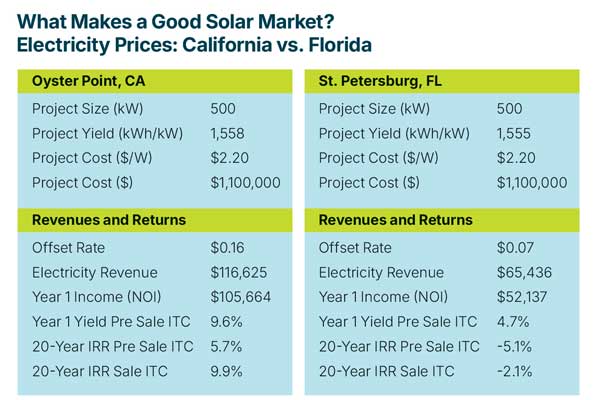
Together, these variables explain why a solar project in California offers fundamentally higher returns than a project of the same size in Florida. For example, electricity prices in California can be roughly twice as high as rates in Florida, a gap that translates into a 500 basis point difference in a 20-year internal rate of return. The market data reflects this: California accounts for 35.2% of total solar installed on real estate by volume, whereas Florida represents only 2.2% of total volume, according to the 2025 Leaderboards.
Community Solar Driving Volume, Growth Among Industrial Owners
Community solar has emerged as one of the most promising structures driving growth and solar deployment at scale. Community solar enables property owners to lease available space to a solar developer, who owns, operates and manages the solar array. A pool of residential subscribers purchases the power, often at a discount, while utility companies retain renewable energy credits to apply toward renewable portfolio mandates. For property owners, this arrangement provides additional rental income, while subscribers gain access to affordable renewable electricity. Beyond financial benefits, hosting a community solar system expands local access to clean energy, strengthens energy efficiency performance and offers visible community benefit — a cost-effective, impactful solution for creating long-term portfolio value. By the close of 2025, community solar accounted for 233.8 MWdc, or over 21% of all tracked capacity.
This structure has been especially beneficial for industrial warehouse owners, who often face significant challenges in deploying on-site solar due to low on-site tenant load, short lease terms and split incentives, resulting in underutilized yet valuable rooftop space. Community solar allows these owners to maximize rooftop capacity and collect predictable roof rent without managing on-site energy users, creating a scalable model to deploy across portfolios where favorable programs exist.
Community solar has also been embraced as an equitable policy solution. Many programs require offtakers to be lower- and middle-income (LMI) households that historically have been left behind in the clean energy transition.
The following hypothetical example, modeled on a 2 MW New Jersey solar project, helps illustrate the underlying economics of a community solar project. The project costs $4 million to build and develop and can generate returns for the solar project owner by selling energy to residents (with a focus on LMI households) at a discount to grid prices. The project is also eligible for state incentives: a utility-paid rate on a dollar-per-kilowatt-hour basis to help incentivize solar development in support of the state’s solar and renewable portfolio standard.
In this instance, the solar project owner would receive just under $300,000 from the electricity sales revenue and another $200,000 from the state incentive payments. In exchange for renting the industrial warehouse rooftop, the developer will share in the project revenues by paying the building owner $120,000 gross rent per year. Therefore, the solar project owner and landlord share in the benefit of deploying solar in that location, all while benefiting residents. This incentive structure has allowed New Jersey to become a leader in hosted rooftop community solar (just over 110 MW to date, according to the Leaderboards).
The Financial Stack
For behind-the-meter (BTM) solar, the most important financial variable is the “value of solar,” or the $/kWh rate. This represents the utility bill charges offset by solar and is calculated as (Utility Cost Before Solar – Utility Cost After Solar) ÷ Annual kWh Generated.
Determining this value requires detailed analysis using a year’s worth of 15-minute interval data and an expert understanding of how to calculate and optimize these rates. This is particularly true in places like California with Time of Use pricing (rate tariffs that charge higher rates at peak times and lower rates at off-peak times), demand charges, and varying rate options and non-bypassable charges.
Click to Enlarge Image Credit: Black Bear Energy, a Legence company
A case study of an installed 600 kW solar project at a California office asset highlights the significant long-term value of BTM installations. Energized in 2017, the system was implemented under a $0.12/kWh power purchase agreement with a 2.7% annual escalator. In the first seven years, the array generated cumulative energy savings and rent of more than $650,000 through 2025, as the value of solar increased from $0.145 to $0.236/kWh.
Additionally, federal tax benefits, such as the investment tax credit (ITC) and modified accelerated cost recovery system/accelerated depreciation, play a significant role in financing solar projects. REITs without a taxable REIT subsidiary (TRS) are unable to monetize these tax benefits, introducing complexity to landlord-owned solar projects. Despite this, the Leaderboards data reveals that nearly half of the capacity has been owned by landlords. This is due in part to many of those leading companies also being owner-operators that have corporate tax liability, selling tax credits or leveraging a TRS. For projects eligible for the 30% ITC, monetizing these tax credits and depreciation increases the return more than 400 basis points. Many REITs without such capabilities rely on third parties to own and operate solar projects on their rooftops in exchange for rent — a downstream solution to benefit from the tax credits offered by the federal government.
With a minimum of 30% of the capital stack dedicated to tax incentives, the commercial solar industry is facing significant near-term uncertainty with repeal of the solar ITC. For projects that didn’t meet the IRS definition of “commence construction” by July 5, 2026, the only remaining path to secure the ITC is project completion by the end of 2027, a rapidly closing window. The industry anticipates a transition period that will likely include developer consolidation, price recalibrations across labor and materials in response to changes in supply and demand, and heightened grid demand driven by AI and data center growth, underscoring the urgency for adaptation in the evolving market landscape.
Industry Adoption at Scale
The latest Leaderboards report reveals that the top five REITs account for 63.6% of total installed capacity, with Prologis leading the charge at 309.4 MWdc. While 62% of projects are BTM based on project count, most of the volume comes from front-of-meter projects, which average 1.17 MW each versus 0.376 MW for BTM. This underscores how community solar and feed-in tariff structures drive large-capacity additions. The 169 MWdc energized in 2025 likely reflects contracts signed two to three years earlier, meaning the pipeline of contracts being signed today will likely define the Leaderboards in 2027 to 2029.
Case Study: LBA Logistics
LBA Logistics and LBA Properties (LBA) has built a repeatable, portfolio-wide solar program in partnership with Black Bear Energy, scaling from 5.9 MW in 2021 to a projected 48.1 MW in 2026. This includes projects in the Maryland Community solar program involving four industrial buildings totaling 2 million square feet and 17.5 MW of solar, generating significant annual roof rent. LBA hosted a subscriber enrollment event for tenant employees, and subscribers receive greater than 10% savings on their electricity bills.
LBA’s comprehensive, best-in-class solar program is supported by defined processes and approvals. This includes a standardized solar lease template and policies that include a reserve space policy, lease language requirements and solar-ready roof guidelines. Monthly portfolio vetting with Black Bear Energy, combined with a structured cross-functional approval process that spans asset management, property management, leasing, legal, joint venture partners and lenders, reinforces and supports program execution.
Best Practices and Takeaways
As the Leaderboards show, real estate professionals are ramping up their deployment of solar, with success ranging from global industry leaders to smaller firms with limited resources. All these groups have identified ways of overcoming hurdles inherent in scaling distributed generation within their real estate portfolios.
To set up solar programs for success, real estate professionals should ensure there is buy-in at the executive level, set clear goals and establish a repeatable, standardized internal approval process before scaling. Updating standard building lease templates to reserve landlord solar rights and negotiating solar provisions in all new mortgage documents will pay dividends. Consulting with an expert can help identify the best assets for solar deployment, evaluate whether the system should be third-party or landlord-owned, and determine whether the energy should be used on-site. Given the significant effort and costs required for each project regardless of size, it is recommended to prioritize larger, high-value projects over smaller projects or projects with lower rental income.
The opportunity exists to deploy solar at scale, as evidenced by forward-thinking real estate owners who are finding ways to monetize their underutilized roofs, parking lots and garages.
Victoria Stulgis is president of Black Bear Energy, a Legence company.