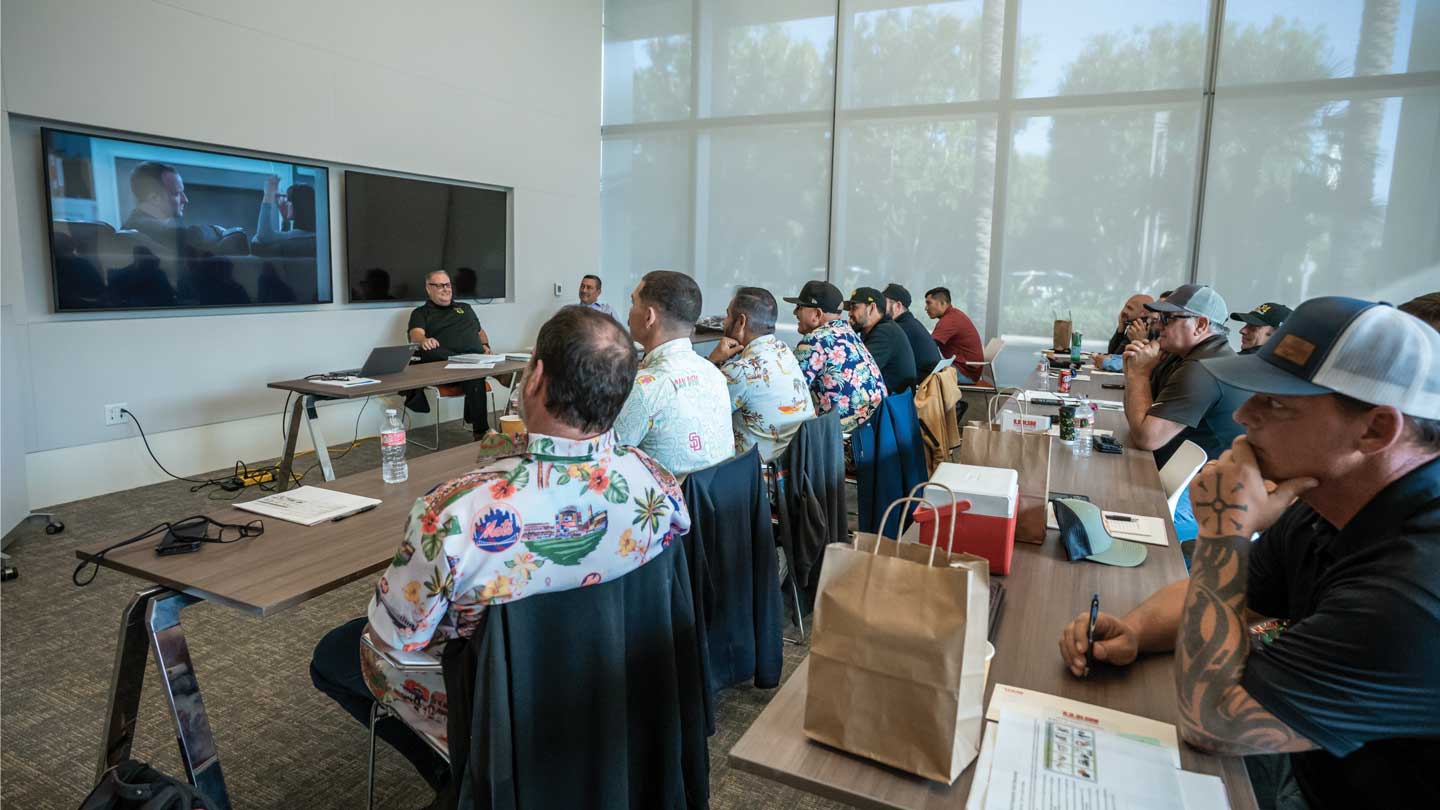
A general contractor developed an in-house training program to build its own pipeline instead of competing for the same shrinking talent pool.
The U.S. construction industry needs an estimated 349,000 workers just to keep pace with demand, according to a 2026 Associated Builders and Contractors estimate. Most construction firms treat workforce development as overhead rather than infrastructure. Those that do invest typically outsource it, licensing curriculum from the Associated General Contractors of America (AGC), National Center for Construction Education and Research (NCCER) certification tracks, or third-party training platforms.
R.D. Olson Construction took a different route. The Irvine, California-based general contractor built its own in-house university: a 61-course program designed and staffed internally. For a regional firm of its size, that is uncommon.
A 2025 study in the International Journal of Construction Education and Research found that of the 323 largest U.S. construction companies, fewer than a third run formal in-house training, and only 40 describe their programs as corporate universities. The companies studied were drawn from Engineering News-Record’s Top 400, the largest contractors in the country. R.D. Olson Construction, with 106 employees, sits well below that tier.
According to Marsh McLennan Agency in 2025, the industry average retention rate was 68%. Current retention rates at R.D. Olson Construction stand at 86%, supported by its annual investment of $500,000 in employee development. Retention is influenced by multiple factors, but R.D. Olson University (R.D.O.U.) gives employees a defined development path and direct access to senior leadership.
“Younger professionals are seeking clear career paths, development opportunities and mentorship, all of which are central to the R.D. Olson University model,” said Kevin Sonksen, director of human resources at R.D. Olson Construction. R.D.O.U.’s curriculum paired with executive mentorship sets internal teams up for long-term success, he added.
An Aging Industry
A generational shift is reshaping the construction workforce as the talent pool shrinks. In 2025, NCCER reported that about 41% of the current construction workforce will retire by 2031, while only 10% of current workers are younger than 25.
That experience cannot be replaced quickly. NCCER estimates that it takes 11 years to train a worker to the skill level of the employee they are replacing, which means the retirement wave will outrun traditional hiring. The shortage is not only about head count but also skill.
In the 2025 AGC-NCCER Workforce Survey, 92% of firms reported trouble filling open positions, and 57% pointed to a lack of skills and qualifications among applicants, according to AGC chief economist Ken Simonson. Closing that gap will require companies to build structured development programs to grow talent internally rather than relying solely on external hiring.
An In-house University
R.D.O.U. offers courses to strengthen business acumen, project management and financial literacy, plus Occupational Safety and Health Administration (OSHA) coursework. The program is designed to develop employees into long-term leaders through structured training and direct mentorship from senior executives. Enrollment is optional, with participants ranging from new hires to those advancing toward executive leadership.
Unlike traditional onboarding, which is often a one-time event, R.D.O.U. is an ongoing development program. It is built on job-specific learning and peer-led instruction, ensuring direct relevance to day-to-day work in the field.
Founded in 2018, R.D.O.U. grew out of a push to provide various avenues to strengthen growth from within. Once conceived, the program took around six months to launch; the educational material was readily available, and mentors were ready to coach.
R.D.O.U. is structured on two key pillars. The first covers technical construction training including project systems, cost management, scheduling and estimating, and the second covers professional development including leadership, communication, team management and decision-making.
The training program is designed to be delivered in focused one- to two-hour sessions taught by senior staff. Mentorship is central to how R.D.O.U. operates, with vice presidents, project managers, and chief operating officers directly guiding associates throughout their professional development.
Career ladders are put in place as formal road maps for executives to outline tasks and success factors at each level. Several R.D.O.U. courses result in formal credentials, including OSHA 10 and OSHA 30, CPR/AED, DiSC behavioral assessment, and harassment-free workforce certifications.
Proof in the Tenure
Career progression at R.D. Olson is merit-based, not time-based. Promotions depend on an individual’s drive and mastery, not necessarily years of service. For example, advancing from project engineer to assistant project manager can take one to three years, all depending on the individual.
R.D.O.U.’s approach is to place employees in challenging roles to accelerate learning through experience. Mentors assign tasks to junior staff on active projects so they learn through live execution with real-time coaching, faster than classroom training alone.
The firm maintains an average employee tenure of 12 years, well above the 2025 Bureau of Labor Statistics industry norm of approximately four years. In addition, it has grown from a small operation to over 100 employees. R.D.O.U. supports retention, reinforced by competitive pay and a semiannual bonus program tied to project profitability. Sustaining that takes investment.
The Cost of Building Internal Talent
R.D.O.U. represents a nearly $500,000 annual investment, funded entirely by the company with no outside subsidies or investors. Costs divide by system upgrades (40%), training (40%) and educational reimbursement (20%). Per employee, the investment ranges from $5,000 to $15,000 annually based on role, assignments and career stage. When operations and accounting teams adopted new systems, training hours ran higher. Field teams have completed added coursework in software, construction techniques and safety protocols, applying those skills directly on the job.
In R.D.O.U.’s first year, the budget was closer to $100,000, with most of the cost going to trainers and volunteer hours. Today that investment is justified by results: an 80% repeat business rate and nearly 30% revenue growth over the past five years.
Turnover has a cost. Replacing a midlevel project manager with an outside hire runs more than $45,000 because new hires can take a couple of years to reach full speed. With company volume projected to grow by $100 million in 2027, the program’s roughly $500,000 annual cost is an investment in reaching that near-term growth and operating at a larger scale long term.
From Intern to Project Manager
In 2019, Cameron Waters joined R.D. Olson Construction as an intern. After advancing through R.D.O.U., he is now a project manager.

Cameron Waters
Early on, he worked alongside his mentor, John Ramirez, COO of R.D. Olson Construction, in various supporting roles, learning in a controlled environment that prepared him for hands-on work in the field. The courses that mattered most to Waters involved day-to-day mechanics, from conceptual bidding to submittals and scheduling.
While working on the Solana at Duarte Station apartments project in Duarte, California, Waters learned how to successfully sequence a project through R.D.O.U.’s construction management course. “The challenge was sequencing the work to allow phased tenant move-ins while we were still building other parts of the complex. The tools from that course got the owner access to begin bringing in tenants early,” Waters said.
Raising the Ranks
Randy Faith, senior project manager at R.D. Olson Construction, joined the company as a project engineer in 2018. Like Waters, Faith found a key mentor in Ramirez during his time in R.D.O.U. Both still work closely with Ramirez today.
For Faith, the toughest challenges were not technical. They revolved instead around leadership and team dynamics. “Through John’s mentorship and the program, I learned how to maintain sharp focus on the project’s needs and unify our team so everyone worked toward a common goal. These challenges weren’t just occasional — they surfaced weekly and sometimes even daily. One of the most demanding aspects of my role was making sure every team member stayed committed not only to delivering a high-quality project but also to providing a level of service that exceeded industry standards,” Faith said.

Randy Faith
Other issues were harder to solve. “One of the biggest challenges has been holding on to the knowledge and skills gained, especially when my role doesn’t allow me to use them regularly,” Faith said. “It’s easy to absorb information during the sessions, but without frequent opportunities to apply what I’ve learned, it can be difficult to keep those lessons fresh and actionable.”
R.D.O.U. attempts to counter that issue by tying coursework to active projects and adding follow-up courses and just-in-time training to keep skills fresh. Still, Faith’s experience shows the challenge hasn’t been eliminated completely.
Building the Next Generation
Drawbacks exist, but so do the results, as exemplified by Waters’ and Faith’s development path through R.D.O.U. The program’s model uses senior staff to train junior employees directly on live projects so that technical skills and leadership skills develop together rather than in separate tracks.
For firms weighing a similar in-house, proprietary approach, the takeaway is to treat workforce development as long-term infrastructure. Over the next three years, R.D. Olson Construction expects its program to produce 15 to 20 promotions.
The purpose of R.D.O.U. is to support growth, but ultimately it is meant to plant the seeds for career development and lay the groundwork for succession planning at R.D. Olson Construction.
Bill Wilhelm is president of R.D. Olson Construction.
A Deeper Dive Into R.D.O.U.’s Course CatalogR.D. Olson University consists of eight core areas of construction practice, combining technical training with leadership and compliance education. Coursework progresses from foundational to advanced, allowing employees to build skills at every stage of their career.
Courses are designated as either qualifications or credentials, with select certifications requiring renewal to keep teams up to date with industry standards. |